AI Search Optimization: A Practical Playbook (2026)
What each AI surface rewards: ChatGPT, Google AI Overviews, AI Mode, Perplexity, and Copilot, with the tactics that actually move each one.
 ChatGPT
 Claude
 Perplexity
 Grok
GrokOn this page
AI search optimization is surface-specific work sitting on one shared foundation. The foundation is eligibility: if AI crawlers cannot fetch your pages, nothing below matters on any engine. Above that, the surfaces diverge sharply enough that a single strategy underperforms on all of them. Across 200 buyer prompts in our August 2026 study, ChatGPT and Perplexity cited zero overlapping domains on 77% of prompts.
This is the execution manual. For what the discipline is, start with the AEO pillar; for the umbrella term, AI SEO.
Where the leverage sits
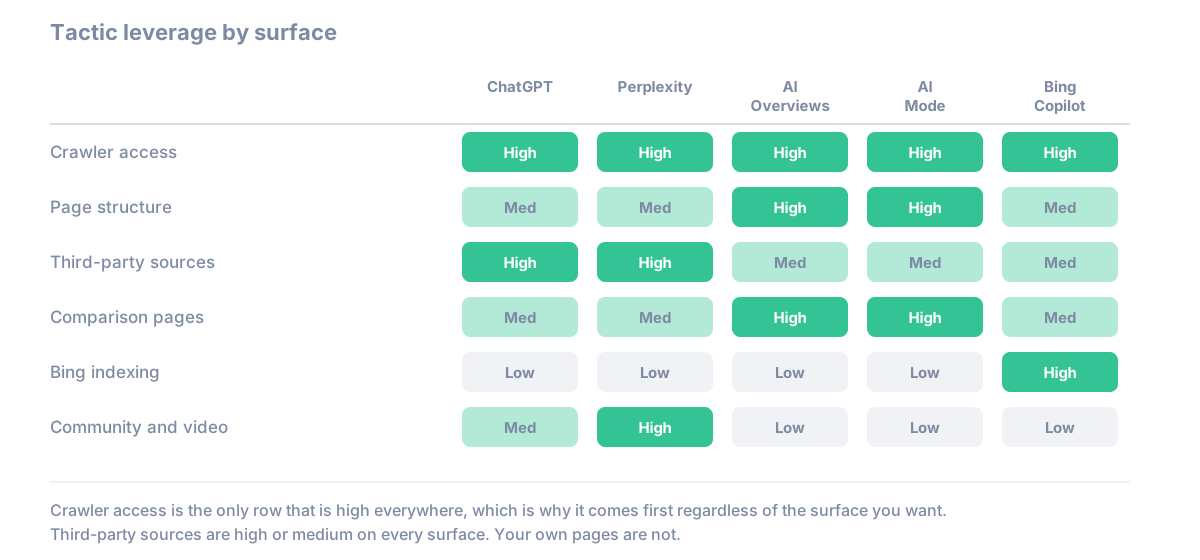
Two readings matter. Crawler access is high-leverage on every surface, which is why it comes first regardless of where you are trying to win. And third-party sources are high or medium everywhere, which is the uncomfortable finding that shapes the rest of this page: vendor-owned domains took 15.3% of ChatGPT's citations and 3.9% of Perplexity's in our study.
The surfaces at a glance
| Surface | Citation behaviour | What it reads | Your main control point |
|---|---|---|---|
| ChatGPT | Cited on 39% of answers, ~1.5 sources | Tech and business media | Third-party coverage, then page structure |
| Perplexity | Cited on 100%, ~9.9 sources | Communities and video heavily | Community and review presence |
| Google AI Overviews | Nearly always cites, few slots | Google's index | Classic SEO, then extractability |
| Google AI Mode | Cites across fanned-out queries | Google's index | Coverage of sub-questions |
| Bing Copilot | Cites, and reports it back to you | Bing's index | Bing indexing hygiene |
Citation figures for ChatGPT and Perplexity come from our 200-prompt study. The rest are behavioural descriptions rather than measured rates, because we have not measured them.
ChatGPT
What it rewards. ChatGPT answers from memory unless the question needs currency, and it cites sparingly when it does search. In our study it attached citations to 39% of answers, averaging 1.5 sources, reaching for tech and business media first: TechRadar appeared in 12% of answers, Forbes 11.5%, G2 6.5%.
Ranked tactics.
- Get into the media and review properties it favours. With 1.5 sources per cited answer, there is almost no room. Presence on the handful of domains that keep appearing for your category matters more here than anywhere else.
- Be consistently described across the web. Memory-mode answers draw on the training corpus, so what third parties said about you last year shapes what it says now. Consistency of your category framing is the lever.
- Allow the search agents.
OAI-SearchBotandChatGPT-Userare separate fromGPTBot; blocking the first two removes you from live answers entirely. See the AI crawlers guide. - Structure pages for extraction, which pays off when retrieval does fire.
The common mistake. Optimizing your own site harder and expecting movement. On the engine with the thinnest citation budget, your own pages are the least likely thing to be quoted. Deeper detail in how ChatGPT picks its sources and ChatGPT rank tracking.
Perplexity
What it rewards. Sources, aggressively. It cited on 100% of the 200 answers we measured, averaging 9.9 sources and drawing on 569 distinct domains. Reddit appeared in 77% of its answers and YouTube in 68%.
Ranked tactics.
- Community presence. If your category is discussed on Reddit and you are absent or misrepresented, that is the single highest-leverage gap on this engine. Participate as a named person answering real questions, not as a brand account.
- Video. YouTube's share of citations is high enough that a competent explainer on your core buying question is a legitimate visibility tactic here and almost nowhere else.
- Review and comparison platforms, which fill the remaining slots.
- Let both agents in. Perplexity documents
PerplexityBotfor indexing andPerplexity-Userfor live fetches.
The advantage worth exploiting. Because it cites everything, Perplexity is the cheapest engine to learn from. Run twenty prompts and you have a ranked list of the domains shaping your category, usable on every other surface. The method is in Perplexity rank tracking.
Google AI Overviews
What it rewards. Ordinary Google eligibility. Google's documentation states a page must be indexed and eligible to show with a snippet, and that there are no additional technical requirements or special optimizations.
Ranked tactics.
- Classic SEO first. Retrieval runs on Google's index, so your existing ranking work is the eligibility layer. This is the surface where AEO and SEO overlap most.
- Write extractable passages. Pew's browsing data recorded a median summary of 67 words with 88% citing three or more sources. Short, self-contained answers under question headings are what gets lifted; the page anatomy is in AEO website structure.
- Prioritise by exposure. Overviews do not appear everywhere. Informational queries triggered one 36% of the time in Seer Interactive's dataset against 5% for transactional, and comparison queries hit 95.4%. Audit your query mix before spending: what triggers AI Overviews.
- Own the comparison surface. At that trigger rate, "X vs Y" pages are where category recommendations get formed.
The common mistake. Treating presence as the goal. Whether an Overview appears is Google's call per query; which sources fill it is the part you influence.
Google AI Mode
What it rewards. Coverage of the sub-questions behind a query. AI Mode fans one question out into several searches, so a page that answers the headline question but none of its parts competes badly.
Ranked tactics.
- Map the fan-out. Take your core buying question and enumerate the sub-questions an engine would need answered. Our free fan-out simulator shows the expansion for a given query.
- Answer the whole family on one page rather than scattering across thin pages, with each sub-question as its own heading and answer block.
- Keep Google's index fundamentals healthy, since AI Mode retrieves from the same place.
More in Google AI Mode SEO tools and the combined Google surfaces guide.
Bing Copilot
What it rewards. Being in the Bing index, which is the most neglected cheap win in this playbook.
Ranked tactics.
- Verify in Bing Webmaster Tools, submit a sitemap, confirm Bingbot is not blocked at the CDN. Boring, fast, and frequently the entire problem.
- Push new URLs through IndexNow so publication-to-eligibility is minutes rather than weeks.
- Read your free citation data. Microsoft reports your actual Copilot citations in the AI Performance report, including per-URL counts and grounding query samples, expanded in June 2026 with citation share and intent classification. No other engine gives you this.
Why it is underrated. Most teams have never done Bing hygiene, so the marginal gain is unusually large for the effort. Full loop in Copilot rank tracking.
Gemini and the rest
Gemini grounds in Google's index, so the AI Overviews tactics largely transfer; the measurement side, including why Gemini gets scored separately from Google's Search surfaces, is in Gemini rank tracking. DeepSeek, Grok, and ByteDance's assistant matter by market and audience rather than universally: Grok folds live X conversation into its answers, which changes the sampling discipline, and DeepSeek documents no crawler at all, which makes prompt sampling the only lens. The honest rule is to measure where your buyers actually are and ignore the rest, because tracking an engine your buyers never open produces numbers no one can act on. For the buyer-side view of how these engines differ, see best AI search engines.
Sequencing, because you cannot do all of this at once
A defensible order for a team starting from scratch:
Week 1: eligibility everywhere. Crawler access, rendering, robots rules, plus Bing verification and IndexNow. Cheap, fast, and it unblocks every surface at once.
Week 2: measure, then pick two surfaces. Baseline your prompt set and choose based on where your buyers actually are, not on engine count. Two surfaces done properly beats five sampled thinly.
Weeks 3 to 6: structure and comparison pages. The work that transfers across every surface: answer-first pages, question headings, and the comparison content both Overviews and assistants lean on.
Week 7 onward: sources. Take the cited-domain list from your baseline and work it. Slowest, highest leverage, and the only tactic that improves every surface at once, since it changes what the corpus says about you.
Re-measure after each phase. Structural work shows within a window or two; source work takes quarters. Expectations by timescale are in the AEO pillar, and the surface-independent playbook is how to do AEO.
What does not transfer
Three tactics people apply across surfaces and should not.
Volume. Every surface cites a small number of sources per answer. More pages does not mean more chances.
Schema as a visibility lever. Useful for entity clarity, not for AI visibility, and FAQ rich results were retired in May 2026.
One conclusion for all engines. The prompt set can be shared; the reading cannot. Report per engine, because a blended number averages away the difference that tells you what to do next. Metric definitions are in what is AI visibility.
Start where the data is cheapest
Two surfaces give disproportionate learning for the effort. Perplexity, because it cites everything and hands you the source map for your category. And Copilot, because Microsoft reports your real citation data free.
Between them you can build the third-party target list that improves every other surface, before spending anything on tooling. The crawl-and-structure prerequisites shared by all five surfaces are in the GEO audit guide. Once you want all five surfaces trended rather than spot-checked, Citlyze samples eight surfaces on a schedule.