AEO Website Structure: H1, FAQ and Schema Strategy
How to structure pages so answer engines can lift your content: H1 rules, question H2s, extractable answers, and what changed for FAQ schema in 2026.
 ChatGPT
 Claude
 Perplexity
 Grok
GrokOn this page
A page an answer engine can use has four properties: one unambiguous H1, headings written as the questions buyers ask, a direct 40 to 60 word answer immediately under each heading, and comparative information in tables rather than prose. Schema helps with entity clarity but no longer does what most AEO guides claim, because Google retired FAQ rich results in May 2026. This page covers the anatomy, then the current state of markup; where structure fits in the discipline overall is the AEO pillar.
The anatomy of an extractable page
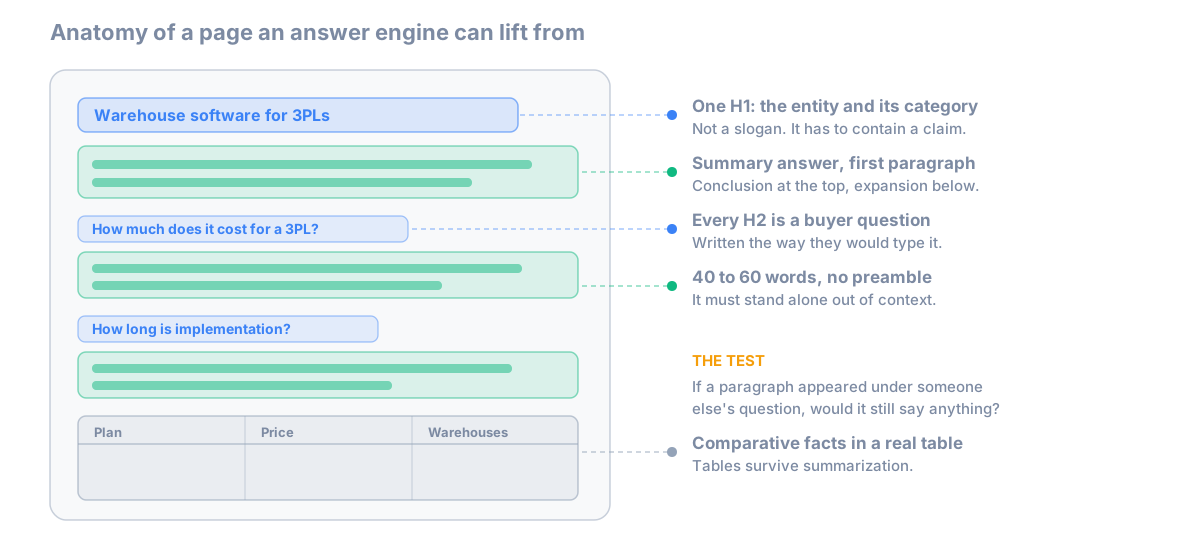
The organizing principle is that an engine takes a fragment of your page and drops it into an answer next to fragments from other sites. Anything that only makes sense in the context of your full page is invisible to that process.
The H1
One H1 per page, naming the thing and the job it does. "Warehouse management software for third-party logistics" works. "Built for the modern warehouse" does not, because it contains no retrievable claim.
Two failure modes are worth naming. A brand-only H1 ("Acme WMS") tells an engine nothing about category membership, which is exactly what it needs to decide whether you belong in an answer about the category. A question-shaped H1 on a commercial page ("Looking for warehouse software?") reads as marketing and competes with the question-shaped H2s doing the real work below.
Question-shaped H2s
Write each H2 as the question a buyer would type, not as a topic label. "How much does warehouse management software cost for a small 3PL" instead of "Pricing". This does two things at once: it matches the queries engines fan out into, and it forces the paragraph underneath to answer something specific.
Mine the questions rather than inventing them. Sales calls, support tickets, and the People Also Ask box are all better sources than a brainstorm, and the method carries over from finding the prompts your buyers ask AI.
The answer block
Under each question heading, put a direct answer of roughly 40 to 60 words, with no preamble. Then expand.
Before:
Pricing
We know that every logistics business is different, and that is why we have designed our pricing to be as flexible as possible. Our team works closely with each customer to understand their unique requirements before recommending a plan that fits their needs and budget.
After:
How much does Acme WMS cost for a 3PL under 50 staff?
Acme WMS starts at $450 per month for up to 10 users and one warehouse, with the Growth plan at $1,200 per month adding multi-warehouse support and EDI. Implementation is a one-time $3,500. Most 3PLs under 50 staff land on Growth.
The second version can be lifted whole into an answer and still make sense. The first cannot be lifted at all, because it contains no information. That is the entire test: if a fragment of the paragraph appeared under someone else's question, would it say anything?
Tables for anything comparative
Plans, tiers, feature differences, and specifications belong in a table. Tables survive summarization better than prose, extract cleanly, and are the format engines reach for when a buyer asks a comparison question. Use real HTML tables rather than styled divs, and keep the header row meaningful.
Put the conclusion at the top
The highest-leverage rewrite on most existing pages costs an hour: move the summary from the end to the first paragraph. Long-form arguments that build to a payoff are good writing for a reader who has already clicked and bad structure for a system that samples the top of the document.
What actually happened to FAQ schema
Most AEO advice still tells you to add FAQPage markup to earn rich results. That advice is out of date, and specifically so.
Google restricted FAQ rich results to well-known, authoritative government and health sites in August 2023. It then removed the feature entirely: FAQ rich results stopped appearing in Google Search on 7 May 2026, the documentation was withdrawn, and Search Console stopped reporting on FAQ structured data. FAQPage remains a valid schema.org type and existing markup causes no harm, but it earns nothing in Google Search.
The distinction that matters: the FAQ format still works, the FAQ markup no longer buys a rich result. A question followed by a concise answer is precisely the shape answer engines extract, whether or not it is wrapped in JSON-LD. So keep writing FAQ sections on product and landing pages. Just stop expecting markup to do the work, and stop reading guides that promise it.
One clarification, because the substitution gets suggested: QAPage structured data still produces rich results, but it describes pages where users submit and vote on answers, like a forum thread. Using it on a marketing FAQ is a guidelines violation rather than a workaround.
The schema worth shipping in 2026
Structured data has moved from a visibility lever to an entity-clarity lever. It helps engines know what your organization is and keeps your facts consistent, which matters for the memory-mode answers no amount of page structure reaches.
Organization is the one to get right, and it still produces a rich result:
{
  "@context": "https://schema.org",
  "@type": "Organization",
  "name": "Acme WMS",
  "url": "https://www.acmewms.com",
  "logo": "https://www.acmewms.com/logo.png",
  "description": "Warehouse management software for third-party logistics providers.",
  "foundingDate": "2019",
  "sameAs": [
    "https://www.linkedin.com/company/acme-wms",
    "https://en.wikipedia.org/wiki/Acme_WMS"
  ],
  "contactPoint": {
    "@type": "ContactPoint",
    "contactType": "sales",
    "email": "sales@acmewms.com"
  }
}
The sameAs array is the part people skip and the part that does the most work: it ties your site to the profiles and references an engine may already associate with your name.
For a software product, SoftwareApplication with real pricing beats a vague Product:
{
  "@context": "https://schema.org",
  "@type": "SoftwareApplication",
  "name": "Acme WMS",
  "applicationCategory": "BusinessApplication",
  "operatingSystem": "Web",
  "offers": {
    "@type": "Offer",
    "price": "450.00",
    "priceCurrency": "USD",
    "priceValidUntil": "2027-01-01"
  }
}
And if you still want machine-readable Q&A on a page, FAQPage is valid and harmless, as long as you understand it is documentation for non-Google parsers rather than a Google feature:
{
  "@context": "https://schema.org",
  "@type": "FAQPage",
  "mainEntity": [{
    "@type": "Question",
    "name": "How much does Acme WMS cost for a 3PL under 50 staff?",
    "acceptedAnswer": {
      "@type": "Answer",
      "text": "Acme WMS starts at $450 per month for up to 10 users and one warehouse. The Growth plan at $1,200 per month adds multi-warehouse support and EDI. Implementation is a one-time $3,500."
    }
  }]
}
Keep every text value identical to the visible answer on the page. Markup that disagrees with the page is worse than no markup.
Worth stating plainly: Google's own AI features documentation says there are no special optimizations necessary for AI Overviews or AI Mode and that you do not need new machine-readable files or markup. Ship structured data for entity clarity and the rich results it still earns. Do not ship it expecting an AI visibility lever.
Files at the root
llms.txt belongs in this conversation and near the bottom of the priority list. No major engine has documented consuming it, the cost is close to zero, and our read on the evidence is in does llms.txt work. Your robots.txt matters far more, because it decides whether any of the structure above is reachable at all: the AI crawlers guide covers which agents to allow.
The page checklist
Run this against your five highest-intent pages before writing anything new. Our free AEO grader scores items 1 to 7 and 9 automatically if you would rather not check by hand.
- One H1, naming the entity and its category.
- A summary answer in the first paragraph, above the fold.
- Every H2 written as a buyer question.
- A 40 to 60 word direct answer under each H2, no preamble.
- Comparative information in a real table.
- Specific claims carrying numbers and sources rather than adjectives.
Organizationstructured data with a populatedsameAs.- Product or pricing facts identical across page, markup, and third-party listings.
- Crawlable and server-rendered for the AI user agents.
- No dependence on your full page for any single paragraph to make sense.
Items one through six will move more than seven and eight will. That ordering is the opposite of how most AEO checklists are written.
After the rewrite
Structure changes are the fastest-moving part of AEO, which makes them the best place to prove the loop works. Take a mention and citation baseline on your prompt set first, ship the rewrite on five pages, then re-measure over the next two windows. The wider playbook this fits into is how to do AEO, and the technical audit that catches eligibility problems before you spend the effort is the GEO audit guide.
If you want that before-and-after measured rather than eyeballed, it is what Citlyze does.
One caution on expectations. A page can be perfectly structured and still go uncited, because structure only decides what happens once retrieval has already put you in the candidate set. If a clean rewrite moves nothing over two windows, the problem is upstream of the page, and no amount of heading discipline will fix it.