AI SEO: The Complete Guide for 2026
AI SEO covers two different jobs: using AI to do SEO work, and being visible in AI search. This guide covers both, with tactics, tools, and measurement.
 ChatGPT
 Claude
 Perplexity
 Grok
GrokOn this page
"AI SEO" describes two jobs that share a name and almost nothing else. The first is using AI to do search work faster: research, clustering, drafting, technical audits at scale. The second is getting AI systems to name your brand when buyers ask them questions. Most confusion in this field comes from people discussing one while meaning the other.
This guide covers both, in that order, and then the part almost nobody writes about: how the two interact, including the specific way combining them badly makes your visibility worse.
Two jobs, one term
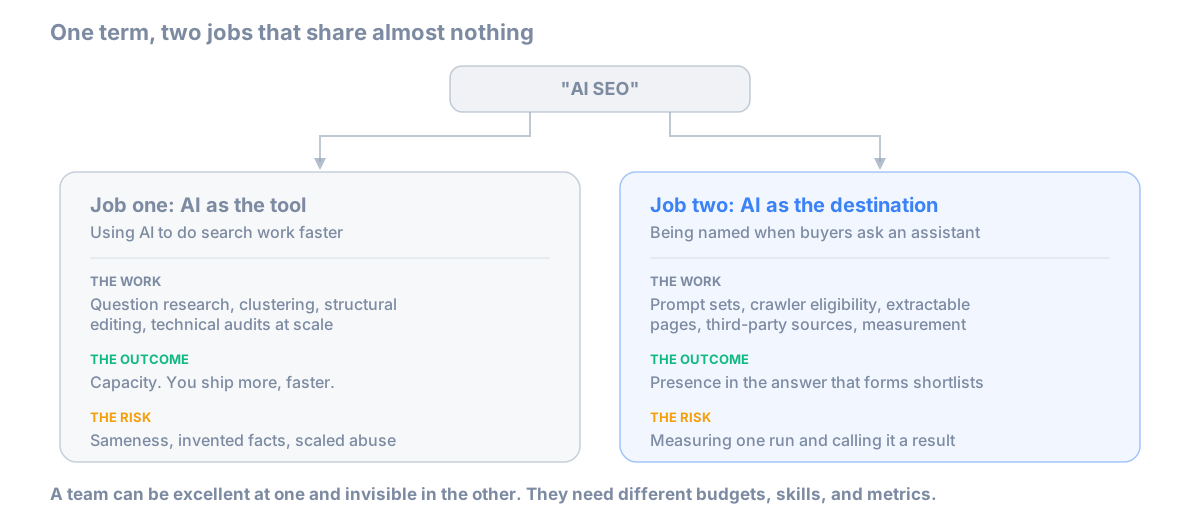
Job one: AI as a tool. You are still optimizing for Google's ten blue links, or for your own content velocity, and AI is the thing doing the work. The outcome is capacity: more pages, faster audits, better research. The risk is sameness and error.
Job two: AI as the destination. Buyers ask ChatGPT or Perplexity instead of searching, get a composed answer naming three or four brands, and form a shortlist without visiting anyone. The outcome is presence in that answer. This is the job also called AEO or generative engine optimization; how the two names relate is covered in AEO vs GEO.
They are not alternatives. A team can be excellent at one and invisible in the other, and usually is. Job one has a mature toolchain and clear economics; job two has a two-year-old toolchain and metrics most teams have never measured.
Part one: using AI to do SEO work
Where AI genuinely helps
Five applications survive contact with real programmes. The common thread is that AI is doing classification, extraction, or first drafts, with a human deciding what matters.
Query and prompt research at scale. Turning a keyword export into intent clusters, or generating the buyer questions your prompt set needs, is exactly the kind of pattern work models are good at; the manual method is in finding buyer prompts.
Intent classification. Labelling a thousand queries as informational, commercial, or transactional used to be a week of someone's life and is now a background job. The output directly drives prioritisation, since trigger rates differ enormously by intent.
Structural editing. The highest-value AI editing pass is not writing prose, it is restructuring: pulling the conclusion to the top, converting topic headings into question headings, and flagging paragraphs that do not answer anything. That maps precisely to what makes a page extractable, covered in AEO website structure.
Technical audits at scale. Crawlers can now call a model mid-crawl, which turns a site audit into a bulk classification job: extract every H1 and ask whether each page answers its own title question, then export the failures. On a large site this is the cheapest leverage available anywhere in SEO.
Internal linking. Finding every page that mentions a concept without linking to the canonical page for it is a retrieval problem, and models handle it well at a scale no human review matches.
Notice what these have in common. None of them is "write the article". The wins are in the parts of SEO that were always tedious classification work.
Keyword research becomes question research
The most consequential change to day-to-day SEO work is not drafting. It is that the unit of demand shifted from keywords to questions, and AI is what makes working at that unit practical.
A keyword export tells you that 2,400 people a month search "warehouse management software". It does not tell you that the buyers who matter are asking "what's the best warehouse management system for a 3PL running three sites on a shared inventory pool", which is the query an assistant actually receives and the shape Google's own trigger data shows is most likely to be answered directly rather than listed.
A workable method:
- Start from real language, not the export. Sales call transcripts, support tickets, and community threads in your category. Feed a model the raw text and ask for the questions being asked, verbatim where possible.
- Expand each into its variants. One buying question has ten phrasings. Models generate these quickly and you keep the ones that sound like your buyers.
- Cluster by the answer, not the wording. Two questions belong together when the same page answers both. This is the classification job models do best and the one that used to eat a week.
- Classify intent per cluster so you know which clusters sit in the high-trigger informational band and which are transactional and largely undisturbed.
- Map clusters to pages, and flag any cluster with no page. That list is your content plan and it is usually shorter than the keyword-driven version.
The output differs from a keyword plan in a specific way: it produces fewer, denser pages that answer a family of related questions, rather than many thin pages each targeting one phrase. That happens to be the shape both Google's helpful content guidance and answer-engine extraction reward.
Google's own AI Mode makes this concrete through query fan-out, where one question becomes several searches behind the scenes. Our free fan-out simulator shows what that expansion looks like for a given query, which is a useful sanity check on whether your page covers the sub-questions an engine will actually run.
Technical SEO at model scale
The second underrated half. Technical SEO has always been bottlenecked by human attention across thousands of URLs, and that constraint largely lifted.
Jobs that now take a few hours rather than a sprint:
- Title and heading audits. Extract every H1 and title, then classify: does the page answer the question its title implies? Does the H1 name the entity and its category, or is it a slogan?
- Cannibalisation detection. Cluster your own pages by the question each one answers, then surface clusters with three pages competing for one answer. Far more accurate than keyword-overlap heuristics.
- Redirect mapping during migrations. Matching old URLs to new ones by content similarity rather than by URL pattern, which is where migrations usually lose traffic.
- Structured data generation and validation. Generating
Organizationand product markup from page content, then diffing markup against the visible page, since markup that disagrees with the page is worse than none. - Log file analysis. Classifying crawler hits by bot and by page type to see which AI crawlers reach what. The user agents worth watching, and the allow-or-block decisions per bot, are in the AI crawlers guide.
- Internal link gap analysis. Every page mentioning a concept without linking to the canonical page for it.
Two cautions. Model output on technical work needs spot-checking against the raw data, because a confident misclassification at scale creates a confident wrong plan at scale. And none of this replaces judgement about which findings matter; an export of 4,000 unprioritised issues still needs a human to decide which ten get fixed.
What Google actually says about AI content
Worth quoting directly, because both the panic and the permission are usually overstated.
Google's helpful content guidance frames the question as intent rather than production method: "If you use automation, including AI-generation, to produce content for the primary purpose of manipulating search rankings, that's a violation of our spam policies." The relevant policy is scaled content abuse. The same document asks whether the use of automation is self-evident to visitors through disclosure. Where that line falls for template-driven page collections, and the publication check that keeps them on the right side of it, is in programmatic SEO.
So the line is not "AI content is penalised". It is that mass-produced content aimed at rankings rather than readers is penalised, and it always was. AI just made it cheaper to produce at a volume that trips the policy.
Where it fails
Hallucinated specifics. Models invent numbers, dates, and citations with total confidence. Every statistic and every source in AI-drafted content needs checking against a primary source. This is not a paranoia tax; it is the single most common way AI content damages credibility.
Sameness. Models trained on the same corpus produce the same framings, the same section structures, and the same examples. In a category where every competitor is prompting similarly, undifferentiated content is a losing position twice: it does not persuade readers, and it gives answer engines no reason to prefer your version.
The volume trap. Publishing fifty mediocre pages because you can is the exact behaviour Google's scaled content policy describes. It also fails on the AI visibility side, for a reason covered in part two: engines cite a small number of sources per answer, and quantity does not increase your odds of being one of them.
Loss of the specific. The things that make content quotable are the things models cannot invent: your pricing, your data, your customers' actual objections. AI is good at structure and bad at substance, and substance is what earns citations.
A workflow that holds up
The pattern that works in practice inverts the obvious one. Instead of AI writing and a human editing, have the human supply what only they have and the AI handle shape.
- Human defines the angle and the evidence. The specific claim, the numbers, the customer language, the sources.
- AI drafts the structure, not the argument: question headings, an answer block under each, a comparison table where one belongs.
- Human writes the load-bearing passages. The ones carrying specifics, judgement, or opinion.
- AI does the classification pass: internal link suggestions, missing entity mentions, paragraphs that answer nothing.
- Human verifies every fact and every link.
The output is slower than full generation and considerably faster than writing unaided, and it survives both Google's policies and the citation test.
The tool market for this half of AI SEO is covered in best AI SEO tools, organized by job rather than by hype.
How to tell if the AI half is working
Job one has its own metrics, and they are not the AI visibility metrics from part two. Confusing the two is how teams conclude that "AI SEO isn't working" when what they measured was unrelated to what they changed.
Throughput, honestly counted. Pages shipped per month is only a win if quality held. Track it alongside the next two metrics or not at all.
Time to first draft versus time to publish. AI compresses the first, and teams often discover it barely moves the second, because review, fact-checking, and approvals were always the real constraint. That finding is worth having early, since it tells you whether the bottleneck was ever writing.
Rankings and traffic on the pages you changed, against a control. The ordinary SEO scoreboard still applies to ordinary SEO work. Keep a set of comparable pages you did not touch.
Error rate. Sample AI-assisted pages and count the factual errors that made it to publication. If that number is not near zero, your verification step is not real, and the eventual cost is credibility rather than rankings.
The trap is judging job-one work by job-two metrics. Publishing thirty AI-assisted pages will not move your ChatGPT mention rate, for the reasons in part three, and concluding that AI is useless for SEO gets the lesson backwards.
Part two: being visible in AI search
What changed
Question-shaped queries increasingly resolve into a composed answer rather than a list of links. Google introduced AI Overviews in 2024 and expanded them past 100 countries within months, while assistants became a search habit of their own. The independent data on adoption and click impact is collected in our AI search statistics.
The consequence for a brand is narrow and severe: where a results page showed ten options, an answer names three or four. Shortlists that used to form across several clicks now form inside one response.
What it does to traffic forecasting
The part that reaches your board deck. Three published findings change how organic forecasts should be built, and each has a scope worth stating.
Clicks fall when a summary appears. Seer Interactive's analysis measured organic CTR dropping around 61% and paid around 68% when an AI Overview is present. Being cited inside the Overview recovers part of it: the same research found roughly 35% more clicks for brands cited versus excluded.
Behaviour changed, not just impressions. Pew's browsing study recorded users clicking a traditional result on 8% of visits when a summary was present, against 15% without one, and ending the session on the results page 26% of the time versus 16%.
Exposure is concentrated, not universal. Informational queries returned an Overview 36% of the time in Seer's dataset against 5% for transactional, so a site weighted toward bottom-funnel terms is far less disturbed than the headlines suggest.
Three practical consequences follow.
First, forecast by query segment rather than in aggregate. Split your query set into the exposed band, meaning informational and comparison queries, and the largely undisturbed transactional band, then apply different CTR assumptions to each. A single blended decay assumption overstates the damage on one band and understates it on the other.
Second, rankings and traffic decouple. You can hold position one and lose clicks because the answer above resolved the question. That makes rank a leading indicator of eligibility rather than a measure of outcome, and it is why the answer-level metrics below exist.
Third, the value of being cited rises as the value of ranking falls. If a summary appears on a third of your informational queries and citation recovers a meaningful share of the lost clicks, then citation share stops being a vanity metric and starts being a traffic input.
None of this supports the stronger claim that organic search is finished. It supports a narrower one: the informational half of your traffic model needs rebuilding on different assumptions, and the transactional half mostly does not. The full set of numbers, with each study's scope, is in AI search statistics.
How answer engines pick sources
Four stages, each a distinct failure point: the engine rewrites the question into several searches, retrieves a candidate set of pages, composes an answer naming a few brands, and attaches citations. Full detail is in the AEO pillar.
The finding that reorders most strategies concerns whose pages fill that last stage. In our August 2026 study of 200 buyer prompts, vendor-owned domains took 15.3% of ChatGPT's citations and 3.9% of Perplexity's. The rest went to reviews, communities, comparison roundups, and media.
Read plainly: AI visibility is mostly decided on pages you do not control. That is why a content-only strategy underperforms here in a way it does not in classic SEO.
The metrics
Five, and none of them come out of a rank tracker: mention rate, citation rate, share of voice, position within the answer, and sentiment. Each is a rate over repeated runs rather than a position, because identical prompts return different answers. Definitions, how to read them together, and why industry benchmarks barely exist are in what is AI visibility.
The one rule that matters more than any definition: every rate needs its run count attached. In our five-run variance subset, only 68.8% of brands that appeared in at least one run appeared in all five. Ask for the run count behind any number before you trust it.
The work
Five workstreams, in the order they pay off: build a buyer prompt set, fix crawler eligibility, restructure pages so passages can be lifted, earn presence on the third-party sources your citations already point to, and measure on a schedule. The ordered version with tactics per step is how to do AEO.
Engines also differ enough that a blended strategy optimizes for none of them. Across the same 200 prompts, ChatGPT and Perplexity cited zero overlapping domains on 77% of prompts. The surface-by-surface execution manual is AI search optimization.
What does not work
FAQ schema for rich results. Google retired FAQ rich results in May 2026. The format still helps extraction; the markup no longer earns a Google feature.
llms.txt as a priority. Cheap and unproven, with no major engine documenting that it consumes the file. Our read on the evidence is in does llms.txt work.
Special AI markup. Google's AI features documentation states there are no additional requirements to appear in AI Overviews or AI Mode and no special optimizations necessary.
Part three: where the two halves meet
This is the section the discourse skips, and it contains both the best opportunity and the worst failure mode in AI SEO.
Using AI to do the AEO work
Four applications where job one directly serves job two.
Generating the prompt set. Your buyer question list is the unit of work for everything in AEO, and drafting forty candidate questions from your category and customer language is a task models do well. Prune by hand; the pruning is where judgement lives.
Classifying answers at scale. Manual scoring of runs is the bottleneck in DIY measurement: 25 prompts times 5 runs is 125 answers to read per window. Classification of mention, position, sentiment, and competitor presence is exactly what a model can do reliably, and it is what tracking products automate. The surrounding report and alert plumbing, from traffic-loss flags to citation-change briefs, is laid out in seven SEO automation workflows.
Analysing the citation list. Once you have a few hundred cited URLs, clustering them by type (review platform, community, comparison roundup, trade press) and by whether they mention you turns a data dump into an outreach queue.
Auditing entity consistency. Ask a model to extract how your product is described across your site, your profiles, and the third-party pages engines cite, then diff them. Inconsistent descriptions are a cheap and common cause of weak visibility. The manual version of that audit, with an entity inventory template, is in semantic SEO.
The failure mode
Here is the trap, and it is worth stating bluntly because it is being sold as a service right now.
Using AI to mass-produce "AEO-optimized" pages does not increase AI visibility, and it can reduce it. Three reasons, each independently sufficient.
Engines cite a handful of sources per answer, selected for relevance and trust, so publishing more pages does not improve your odds of being one of them. Most citations go to third-party domains, so the marginal page on your own site competes for the smallest share of the citation pool. And generated content lacks the specifics, the numbers, the pricing, the actual comparisons, that make a passage worth quoting in the first place.
The approach that fits how these engines actually select sources is the opposite: fewer pages, more specific, plus sustained work on sources you do not own. The editorial discipline behind "more specific" is adding information gain to a page: resolve a question the existing pages leave open instead of restating them. That work is slow, unglamorous, and largely un-automatable, which is precisely why it is defensible.
A 90-day plan across both halves
Days 1 to 14: measure and audit. Build a 20 to 40 prompt buyer question set. Take a manual baseline, five runs per prompt on two engines, scoring mentions, citations, and competitors. In parallel, run a crawler-access audit using the GEO audit guide, because everything downstream assumes engines can reach you.
Days 15 to 30: fix eligibility and structure. Clear whatever the audit found, then restructure your five highest-intent pages answer-first. Use AI for the structural pass and a human for the specifics.
Days 31 to 60: work the sources. Rank the cited domains from your baseline. Take the top three that do not mention you accurately and start outreach. This is the slowest and highest-leverage item on the list.
Days 61 to 90: re-measure and decide. Run the same prompt set again. Structural changes should show first. If nothing has moved and eligibility is clean, the answer is almost always that the third-party layer needs more time, not that the strategy is wrong. Timescales are set out in the AEO pillar.
Throughout, keep doing classic SEO. Nothing in part two replaces it, and the pages that get cited in answers are overwhelmingly pages that were already eligible to rank. AEO vs SEO works through exactly which parts of your existing programme carry over and which do not.
Tools, briefly
For job one, the market splits into content optimization, classic suites with AI features bolted on, and crawlers that can call a model mid-crawl. Compared with real pricing in best AI SEO tools.
For job two, you need repeated-run sampling across the engines your buyers use, with the cited-source list stored, not just whether your domain appeared. The category is compared in best AI visibility tools, the AEO-framed cut is in best AEO tools, and the buying checklist is how to choose an AI visibility tool. What the whole programme costs, including agencies, is in how much AEO costs.
We build Citlyze for job two, which is the disclosure that should make you check the comparisons above rather than take our framing on trust.
What this does to the SEO role
The honest version, since "will AI replace SEOs" is one of the most-asked questions in this category and mostly gets answered with reassurance rather than specifics.
What genuinely shrinks. Tasks that were classification, extraction, or first-draft production. Briefs, meta descriptions, bulk audits, keyword grouping, and the long tail of thin supporting pages that only ever existed to catch phrase variants. If a large part of a role was producing volume, that part is under real pressure.
What grows. Three things, and they are the reason the role does not vanish. Judgement about what to publish, which is a strategy question no model has your context for. Verification, which becomes a formal step rather than an assumption once drafts are machine-produced. And relationships, because the third-party sources that decide AI visibility are earned through outreach, not published.
What is genuinely new. Measurement of a surface that did not exist three years ago. Nobody's 2019 skill set includes designing a prompt set, reasoning about sampling variance, or turning a cited-domain list into an outreach plan, and those are now core competencies.
The shape of the job moves from producing pages toward deciding what deserves to exist and making sure the sources that shape your category are accurate. That is a more senior job description than the one it replaces, which is good news unevenly distributed: it is harder to enter the field and more valuable to be good at it.
What to ignore
"SEO is dead." Retrieval still runs on search infrastructure, transactional queries barely changed, and the trigger data shows exposure concentrated in informational search rather than everywhere. The longer argument, with dated predictions, is in the future of SEO.
Guaranteed placement in AI answers. Nobody sells it, and generation is probabilistic.
Single-check visibility reports. A single run per prompt is too small a sample to conclude anything from. See why AI answers change.
Anyone quoting an industry benchmark mention rate. Category concentration and prompt-set composition make cross-industry comparison close to meaningless.
Where to start
If you have not measured, measure: ten commercial buyer questions, five runs each, done in a single sitting, on the two engines your buyers actually use. That baseline decides which half of AI SEO your real problem sits in, and the two halves need entirely different budgets.
The likely discovery is that your content operation is fine and your distribution assumption is broken. That is an uncomfortable finding and a cheap one to obtain.