Grok Rank Tracking: How to Monitor Your Brand in Grok
How to track your brand in Grok answers, why live X conversation makes Grok the most volatile engine to measure, and which tools actually cover it.
 ChatGPT
 Claude
 Perplexity
 Grok
GrokOn this page
Grok rank tracking asks for more discipline than any other engine's, because Grok folds the live X conversation into what it says about your brand. An answer that recommends you on Monday can cool off by Thursday after a thread goes sideways, with nothing on the web having changed. That volatility is the surface working as designed, and your measurement has to be built for it.
Grok answers move with X
Grok retrieves from the web like its peers, and it also reads current posts on X. That second input is what separates it. Most engines lean on pages that change weekly at most; Grok leans partly on a feed that changes by the minute. For brands this cuts both ways: a strong product launch that lands well on X can surface in Grok answers faster than any crawler would find your announcement page, and a pile-on can shade how you are described just as quickly.
For measurement, the consequence is blunt. A single Grok check is a snapshot of a moving feed, so rates over repeated runs are the only numbers worth reporting, and week-over-week trends matter more than any single day. The general case for run counts is in why AI answers change; Grok is that argument at its strongest.
What to measure
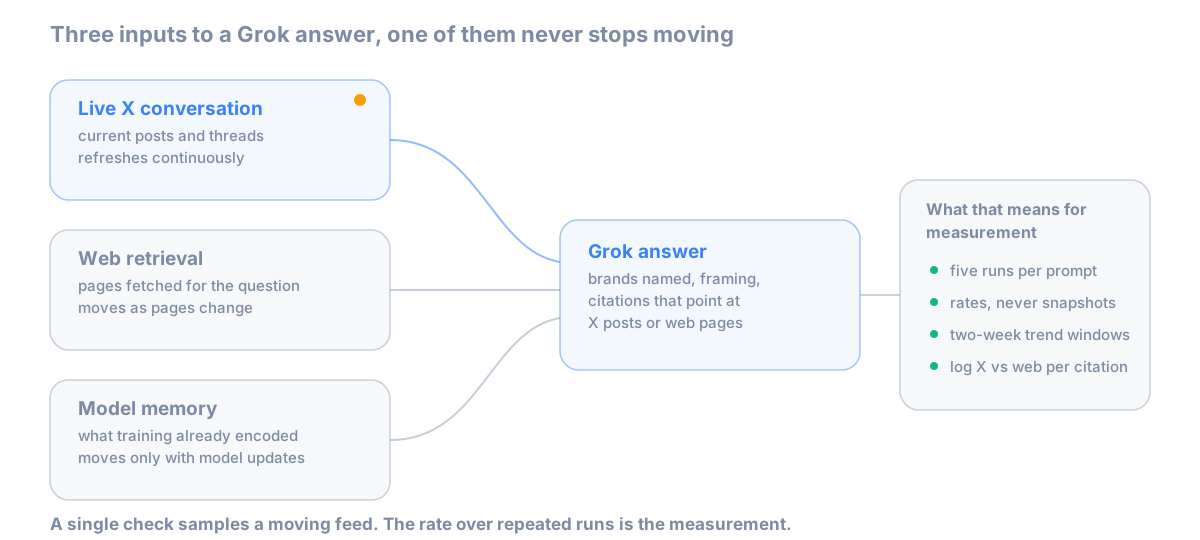
Score the standard four fields per run: brand named, position among the brands named, your domain among any cited sources, and which competitors appeared. Then add the column that is specific to Grok: for each citation, whether it points at an X post or a web page. The split matters because the fixes are different jobs. Web citations respond to the usual page-level work. X citations respond to presence in the conversation itself, which belongs to whoever runs your community and social effort, not your content calendar.
Scoring Grok answers by hand
The manual protocol follows the shape in tracking brand mentions in AI search, with Grok's wrinkles baked in.
- Freeze a set of 20 to 40 buyer questions and keep it identical between windows.
- Use a clean account. Grok ties to an X account, and your own timeline and follows are context you do not want in the measurement.
- Fresh thread per run, five runs per prompt minimum. Five is the floor elsewhere; on Grok treat it as the minimum and be suspicious of any weekly rate built on fewer.
- Record source type per citation, X post or web page, alongside the four standard fields.
- Fix your market and keep it constant between windows.
- Judge trends on two-week windows. Day-to-day movement on Grok includes X weather. Two clean weekly rates tell you whether something real moved.
GrokBot, and whether to let it in
xAI does operate a crawler, GrokBot, and it sits in the training category rather than the live-retrieval category. Letting it in is a decision about whether your content trains xAI's models, not a switch that changes next week's answers, so treat it with the same framework you use for GPTBot and Google-Extended in our AI crawlers guide. If your goal is being recommended by Grok, the conversation on X and the web pages Grok retrieves are the levers that move within a quarter.
Tools that track Grok
Grok coverage is thin and often tier-gated, so confirm both the engine list and the plan tier before buying. Citlyze tracks Grok daily on Brand Pro and above, not on the $29 entry plan, scoring the same mention, position, citation, and share-of-voice fields as its other engines; the Grok visibility tracker page shows what we sample there, and Citlyze is ours, for the record. Rankscale includes Grok from $20/month at the light end of the market, and Promptwatch covers it from $95/month. The tier-by-tier comparison across the whole category, including the tools that skip Grok entirely, is in best AI rank trackers, and this article will not repeat it.
Free Grok rank tracking
There is no first-party citation report for Grok and no analytics surface that breaks out Grok referrals cleanly, so free tracking means the manual protocol above. It is genuinely workable at 20 prompts: an hour or two a week, and you develop a feel for how volatile your prompts really are, which no summary number conveys. The paid tools earn their fee when the prompt set grows, when you want competitors scored on the same runs, or when volatility makes manual sampling too noisy to trust.
Run it for two weeks before judging it
Take your twenty buyer prompts, run them five times each this week and next, and score the four fields plus the X-versus-web source column. Resist reading anything into week one alone. The two-week picture tells you whether Grok knows your brand, how it frames you, and whether the conversation feeding it is one you are part of. If you want the sampling to arrive on a schedule while your team works the X side, Citlyze runs it daily on the plans that include Grok.