Google AI Mode SEO: Tools and Rank Tracking (2026)
How Google AI Mode differs from AI Overviews, what query fan-out means for your visibility, and which tools actually track your brand inside it.
 ChatGPT
 Claude
 Perplexity
 Grok
GrokOn this page
Google AI Mode is not AI Overviews with a different name, and tools that treat the two as one surface measure both badly. An Overview is a block bolted onto a classic results page. AI Mode is a separate conversational tab where the results page disappears entirely: no blue links below the answer, no position to fall back on, just a composed response and its sources. If AI Overviews shrank the value of ranking, AI Mode removes the consolation prize.
That raises two practical questions: what does "SEO" even mean on a surface with no rankings, and which tools can see whether you exist there. Both have concrete answers.
Fan-out: the mechanic that changes the game
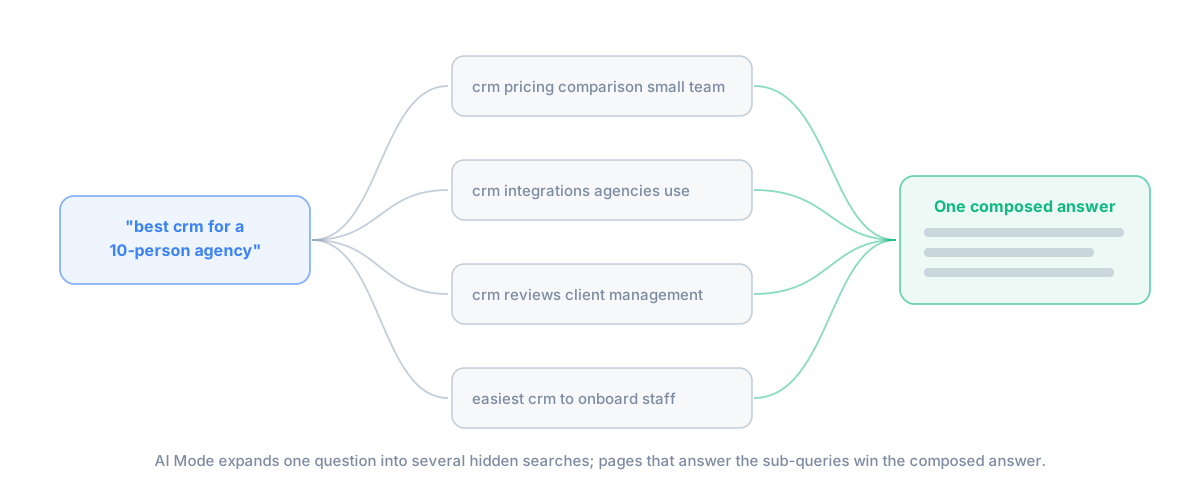
AI Mode runs query fan-out: it expands your buyer's single question into multiple hidden sub-queries, retrieves for each, and composes one answer from the winners, as Google describes in its own AI Mode announcements. The SEO consequence is real: a page that would rank #4 for the head query can dominate the composed answer by being the best result for two of the sub-queries nobody sees. Optimizing for AI Mode therefore means covering the question space around your topic, not one keyword. You can preview what that expansion looks like for your own queries with our free query fan-out simulator, and for prompts you track, Citlyze records the sub-queries engines actually ran behind each answer on its query fan-out tracking view. The content strategy the expansion implies, deep coverage of adjacent buyer questions, is the same one behind finding the prompts your buyers ask AI.
Make the mechanic concrete with the example in the diagram. "Best CRM for a 10-person agency" plausibly fans out into pricing comparisons, integration questions, review lookups, and onboarding-difficulty checks. A CRM vendor with a strong homepage and nothing else loses every one of those sub-queries: the pricing sub-query goes to a competitor's transparent pricing page, the integration one to a marketplace listing, the review one to a third-party roundup. The vendor that wins the composed answer is the one whose site, or whose third-party footprint, holds a genuinely good page for each fragment. That is why AI Mode punishes thin sites harder than classic search ever did: one great page used to be enough to rank, and now the question space is the unit of competition.
Because the sub-queries are invisible, you cannot audit your way to certainty here. You measure outcomes instead: does the composed answer mention you, cite you, and do so more often than it does your competitors. Since 2026 the answer can also carry ads, which belong in a separate count.
What changes for measurement
Two SERP habits break on this surface. There is no displacement metric, because there is no results page to be displaced from: your classic rank for the head query says little about your presence in the composed answer, so AI Mode data has to be read on its own rather than as a modifier on rankings. And single-prompt tracking undershoots, because fan-out means one buyer question touches many retrievals; tracking a cluster of related prompts per topic reads the surface far better than one exact-match prompt per keyword. Sampling discipline carries over unchanged: composed answers vary run to run like every generative surface, so rates over repeated runs remain the unit of truth.
Tools that track AI Mode
The field is thinner than for AI Overviews, because AI Mode is harder to sample and several major platforms simply skip it.
Citlyze
Citlyze tracks AI Mode as its own engine, weekly, on every plan from $29/month: brand mentions in the composed answer, cited domains split owned versus competitor versus third-party, and trends over time, separate from the AI Overviews numbers so the two surfaces never blur. Details on the Google AI Mode tracker page; grade us with the buyer's guide checklist like anyone else.
Who else covers it
Otterly.AI, Rankscale, Knowatoa, Scrunch AI, AthenaHQ, Peec AI, and Ahrefs Brand Radar all list AI Mode among their engines, at price points from $20 to $328/month. Depth varies more than the checkbox suggests: at evaluation time, ask specifically whether the tool captures cited domains inside AI Mode answers or only detects your brand string.
Who skips it
As of our July 2026 review, Profound, Promptwatch, and the Semrush AI Toolkit do not list AI Mode coverage. If AI Mode matters to your market, and for question-shaped commercial queries it increasingly does, check this row before anything else in the comparison table; the full grid is in best AI visibility tools.
What to do about AI Mode, in order
- Measure first. Run your money prompts through AI Mode manually this week, fresh sessions, and log who gets mentioned and cited. The variance rules from tracking brand mentions in AI search apply here unchanged: repeated runs or it is not data.
- Cover the fan-out. For each money prompt, use the simulator to see likely sub-queries, then check whether any page of yours is genuinely the best answer to each. The gaps are your content queue.
- Fix the same fundamentals. AI Mode retrieves through Google's index, so crawlability, extractable structure, and entity clarity carry over; the working checklist is the GEO audit guide.
- Do the same for Microsoft's surface if Bing matters in your market, where the tracking economics are unusually favourable: see Copilot rank tracking.
- Track continuously and treat AI Mode's numbers separately from Overviews. The surfaces select differently, and a brand can be strong in one and absent from the other; our broader guide to both Google AI surfaces covers optimizing each.
Where this surface is heading
Google keeps moving AI Mode toward the center of Search, and every quarter more question-shaped queries default to composed answers. The brands that will look prescient in a year are the ones with a baseline now: mention rate, citation share, competitor split, trended weekly. A Citlyze trial gives you that baseline for AI Mode and seven other surfaces in one run, 14 days, no card.