DeepSeek Rank Tracking: How to Track Your Brand Visibility
How to track your brand in DeepSeek answers when the vendor documents no crawler: a sampling protocol, the honest unknowns, and the tools that cover it.
 ChatGPT
 Claude
 Perplexity
 Grok
GrokOn this page
DeepSeek rank tracking means running your buyer prompts through DeepSeek on a schedule and scoring what comes back, and it is the engine where sampling is not just the best method but the only one. There is no documented crawler to check in your robots.txt, no first-party citation report to export, and no webmaster console to verify. What DeepSeek says about your brand is knowable only by asking it, repeatedly, and writing down the answers.
The engine with no crawler to check
Most engine playbooks start with access: is the bot allowed in, is the page indexed, does the citation log show you. DeepSeek removes that entire layer. As of August 2026, DeepSeek's public documentation lists no crawler user agent, which means there is no robots.txt line to audit and no way to confirm or influence what its systems fetch. Guides that tell you to unblock a "DeepSeekBot" are describing a token that does not appear in any DeepSeek documentation we can find.
That absence is worth stating plainly because it changes what an honest tracking program can claim. You cannot verify eligibility, so you measure outcomes: what the answers actually say. It also means the crawler-side habits from our AI crawlers guide have no DeepSeek chapter yet. If that changes, the registry-based tools will pick it up quickly; until then, treat any vendor promising "DeepSeek crawl optimization" with suspicion.
The app is not the only place DeepSeek answers
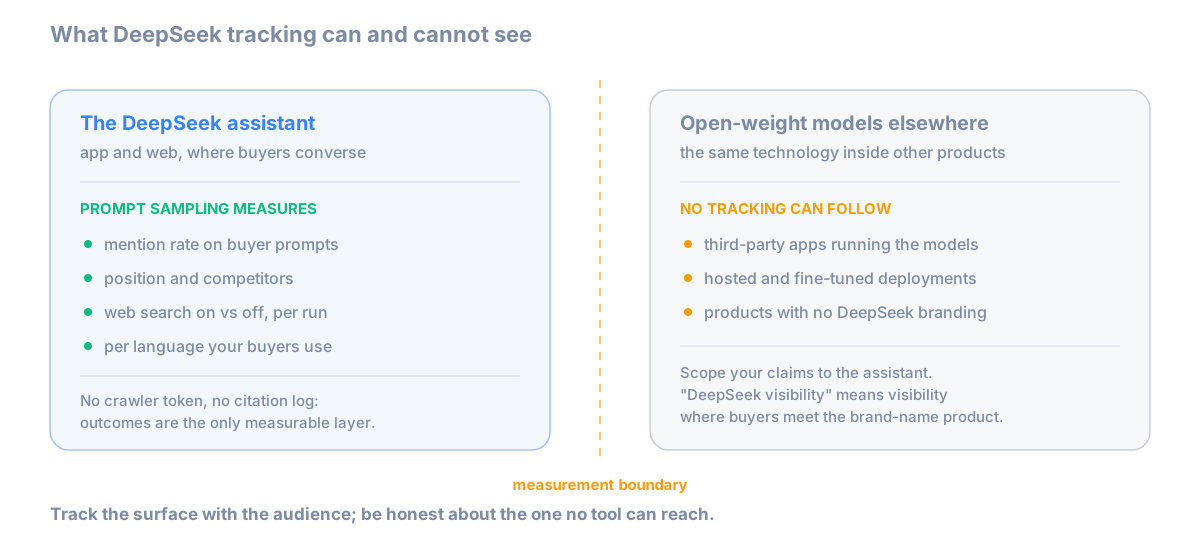
DeepSeek releases open-weight models, so its technology also runs inside third-party products, hosted deployments, and tools that never show a DeepSeek logo. Your prompt sampling measures the DeepSeek assistant, the app and site where buyers actually converse with the brand-name product. It cannot see what a fine-tuned deployment inside someone else's product says, and no tracking tool can. Scope your claims accordingly: "our DeepSeek visibility" means visibility in the assistant, and that is the surface with an audience worth measuring.
What to measure
The standard four fields per run: brand named, position among named brands, your domain among cited sources when the answer shows them, and competitors on the same runs. Add a fifth column for DeepSeek: whether web search was on for the run. DeepSeek answers the same category question very differently with search enabled and without it, one drawing on live pages, the other on what training encoded, and a mention rate that mixes the two modes is a rate of nothing in particular. Track them as two lines or fix the mode and say which one you measured.
Tracking DeepSeek by hand
The protocol follows tracking brand mentions in AI search, with the DeepSeek specifics folded in.
- Start from the same 20 to 40 buyer questions you track on other engines, so DeepSeek's rates are comparable to theirs.
- Run prompts in the languages your buyers actually use. This matters more for DeepSeek than for any Western-default engine: it grew into a mainstream assistant with a strongly international audience, and your English mention rate says little about what a buyer asking in Chinese, Spanish, or German hears. Pick the two or three languages that match your market and keep separate sheets.
- Fresh chat per run, five runs per prompt. The variance argument from why AI answers change applies in full.
- Fix the web-search mode per run and record it.
- Weekly cadence, with rates computed per mode and per language.
Tools that track DeepSeek
Coverage is the thinnest of any engine in this series, so read a vendor's published engine list before believing its homepage. Citlyze tracks DeepSeek daily on every plan, from $29/month, with mention, position, citation, and share-of-voice scoring and visible run counts; the DeepSeek brand monitoring page shows the surface in detail. Citlyze is our own product, so the trial is the honest test of that claim. Among the others, Rankscale lists DeepSeek in its engine coverage from $20/month, and Promptwatch includes it from $95/month. The wider field, including the majority of tools that skip DeepSeek entirely, is compared in best AI rank trackers.
What free covers here
Free DeepSeek tracking is the manual protocol and nothing else. No first-party data exists, and the multilingual wrinkle actually favors manual work at the start: you want a human reading the answers in each language anyway, because framing and sentiment do not survive translation summaries. A 20-prompt set in two languages costs a few hours a week. The paid tools take over when the language-times-mode matrix outgrows a spreadsheet, which it does quickly at more than two languages.
Sample it before you staff it
Before DeepSeek earns a line in your reporting, spend one week learning whether it matters for you: twenty prompts, five runs each, in your primary two languages, with the web-search mode logged. If DeepSeek rarely names brands in your category, note that and re-check quarterly. If it names your competitors and not you, you have found a surface worth working, and the playbook is the same measurement loop as everywhere else. Citlyze runs DeepSeek daily on every plan, for teams that prefer starting from data over starting from an empty spreadsheet.