Copilot Rank Tracking: How to Track Your Brand in Microsoft Copilot
Microsoft Copilot answers ride the Bing index. How to track whether Copilot cites and recommends your brand, using free first-party data and prompt-level tools.
 ChatGPT
 Claude
 Perplexity
 Grok
GrokOn this page
Copilot rank tracking has one advantage no other AI engine offers: Microsoft publishes your citation data for free. The AI Performance report in Bing Webmaster Tools shows how often your pages are cited as sources in Copilot answers, at the URL level, at no cost. Everything else about tracking Copilot follows from pairing that first-party log with prompt-level sampling, because the two answer different questions and neither is sufficient alone.
Copilot runs on the Bing index
Copilot does not maintain a separate crawl. It retrieves candidates from the Bing index and composes a cited answer over them, which makes Bing indexing the eligibility layer for the entire surface. Practically, that means the boring Bing hygiene most teams skipped for a decade now gates an AI channel: the site verified in Bing Webmaster Tools, a submitted sitemap, Bingbot unblocked at the CDN and in robots.txt, and new URLs pushed through IndexNow so publication-to-eligibility is minutes rather than weeks.
This is the cheapest work in AI visibility and the most commonly skipped. Before you evaluate a single tracking tool, confirm Bingbot can reach you, because a Copilot tracker pointed at an unindexed site will faithfully report zero forever.
Two lenses, and what each one misses
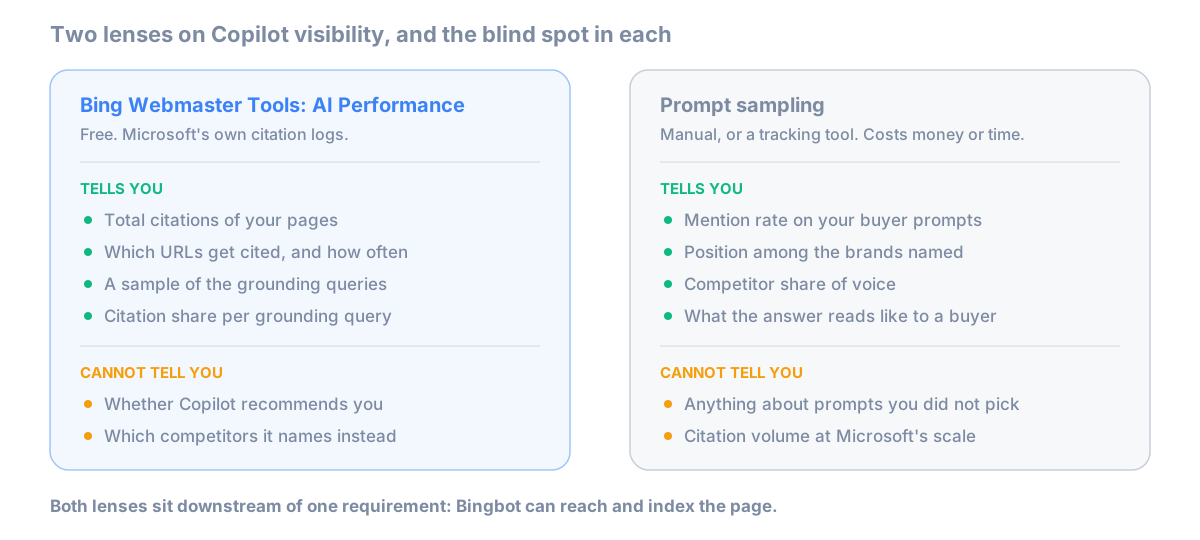
Lens one: your citation log. Bing Webmaster Tools' AI Performance report, in public preview since February 2026, reports total citations of your content across Copilot, AI-generated summaries in Bing, and selected partner surfaces, plus the average number of unique pages cited per day, per-URL citation counts, and a sample of the grounding queries the AI used when it retrieved your content. A June 2026 expansion added intent classification, topic clustering, period-over-period comparison, and Citation Share, the percentage of all citations for a grounding query that went to your site.
Read the caveats in Microsoft's own words before you build reporting on it. Grounding query data is a sample rather than a census, metrics are aggregated across AI surfaces without ranking detail, and Microsoft states plainly that Citation Share is observational rather than a competitive scoreboard: it does not expose competitor domains or represent traffic share.
Lens two: prompt sampling. Run your buyer prompts through Copilot repeatedly and score the answers. This is the only way to learn what the citation log structurally cannot tell you: whether Copilot recommends you, which competitors it names instead, and how the answer reads to a buyer. Citations and recommendations are not the same event. Being cited as a source for a factual claim while a competitor gets the recommendation is a common and specific failure, and only sampling catches it. Our piece on crawl versus citation covers the equivalent gap one step earlier in the chain.
Run both. The citation log tells you which of your pages Microsoft's systems actually reach for, at a volume no sampling budget can match. Sampling tells you what buyers see.
Scoring Copilot answers by hand
The manual protocol is the same shape as tracking brand mentions in AI search, with two Copilot-specific wrinkles.
- Use 20 to 40 buyer-question prompts, in full sentences, and keep them fixed. Changing the prompt changes the measurement.
- Sign out, or use a clean profile. Copilot personalizes on Microsoft account context, and enterprise tenants add their own grounding. Measuring from your work account measures your tenant, not the public web.
- Score four fields per run: brand named, position among named brands, your domain present in the cited sources, and which competitors appeared.
- Set the location deliberately. Copilot answers shift by market. Pick your primary market, keep it constant, and note it in the sheet.
- Weekly cadence is enough. Copilot's answers move with the Bing index rather than with a chat model's sampling temperature, so week-over-week windows catch real movement without burning hours every day.
Five runs per prompt per week gives you a mention rate you can defend. Fewer than three, and you are reporting noise, for the reasons laid out in why AI answers change.
Tools that track Copilot
Copilot coverage is thinner than ChatGPT or Perplexity coverage, and it is frequently gated behind higher tiers, so check the plan and not just the feature list.
Citlyze
Citlyze tracks Bing Copilot weekly on every plan, from $29/month, scoring brand mentions and capturing the sources cited in each answer alongside the other seven surfaces it tracks. Copilot coverage shipped in July 2026. The Bing Copilot tracker page shows what a tracked prompt looks like there. We build Citlyze, so the honest framing is that Copilot is a weekly surface here rather than a daily one, which matches how fast its answers actually move.
Profound
Profound includes Copilot in its Enterprise tier's nine-engine coverage. The $99 Starter plan is ChatGPT only and the $399 Growth plan covers three engines, so Copilot on Profound means a sales conversation.
Scrunch
Scrunch sells into agencies and enterprise teams from $300/month billed monthly, or $250/month billed annually, with a broad platform list on every tier. Copilot tracking there arrives inside a heavier platform than most teams tracking one Microsoft surface need.
Semrush
If you already pay for Semrush, its AI visibility tracking is bundled into the Starter tier and above, from $199/month, with 50 prompts tracked daily. For teams whose Copilot question is a small part of a wider SEO program, the marginal cost of checking is zero.
What free actually covers
Copilot is the one engine where "free rank tracking" is close to a real answer. Bing Webmaster Tools costs nothing, and after the June 2026 update it reports citation counts, per-URL detail, grounding query samples, intents, topics, and Citation Share. No third-party tool has access to that data, because it comes out of Microsoft's own logs.
What it will not do is name your competitors, tell you whether Copilot recommends you, or measure prompts you have not already been cited for. That is the boundary where paid sampling starts earning its price, and it is worth being clear about which side of it your question sits on before you buy anything.
The first week
Verify the site in Bing Webmaster Tools, open AI Performance, and export the grounding queries and per-URL citation counts. That is your baseline, free, in a single sitting. Then take the twenty prompts your buyers actually ask, run them against Copilot five times each, and put the mention rate next to the citation data. The two together tell you whether Microsoft's systems can find you, and whether finding you leads anywhere. If you would rather have the sampling half arrive on a schedule, that is what Citlyze runs weekly.