How to Do AEO: 7 Techniques That Work in 2026
A working AEO playbook: prompt research, eligibility, answer-shaped content, third-party sources, and the measurement loop that tells you if any of it worked.
 ChatGPT
 Claude
 Perplexity
 Grok
GrokOn this page
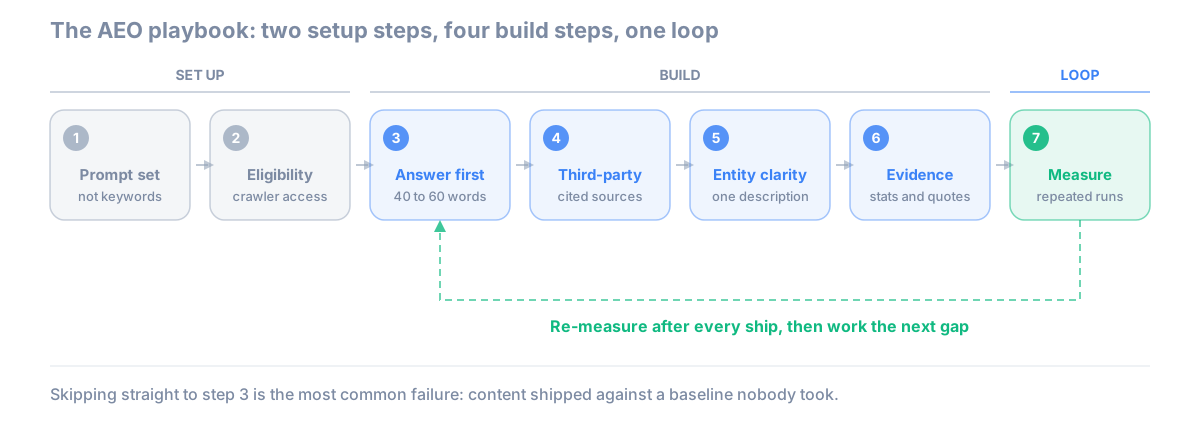
Answer engine optimization work falls into seven techniques, and the order matters more than any individual one. Two setup steps decide whether you are eligible and whether you can tell if anything worked. Four build steps do the actual optimization. The seventh closes the loop. Skip straight to step three, as most playbooks encourage, and you end up shipping content against a baseline you never took.
This page is the doing, surface-independent. For what the discipline is and where it came from, start with the AEO pillar; for tactics ranked per engine, AI search optimization; for the wider term that covers using AI to do SEO work as well, the AI SEO guide.
The playbook
1. Start from a prompt set, not a keyword list
Buyers type full sentences into assistants: "best warehouse management software for a 30-person 3PL", not "warehouse software". Engines then fan that out into several searches of their own. A keyword export approximates this badly.
Build 20 to 40 real buyer questions spanning three shapes: money questions ("best X for Y"), comparison questions ("A vs B"), and problem questions ("how do I stop X happening"). Sources worth mining are sales call recordings, support tickets, the questions your best sales rep gets asked twice a week, and the autocomplete on the assistants themselves. The full method is in finding the prompts your buyers ask AI.
This list is the unit of work for everything that follows. Fix it before you write anything.
2. Fix eligibility before you fix content
Every downstream technique assumes engines can fetch your pages. Often they cannot, and the cause is rarely robots.txt.
Check four things: robots rules for the search and live-fetch agents (OAI-SearchBot, ChatGPT-User, PerplexityBot, Perplexity-User, Claude-SearchBot), bot protection at the CDN, which routinely blocks AI crawlers under a generic rule nobody remembers writing, whether your key pages render server-side, and whether your important content sits behind interaction. The AI crawlers guide covers the agent inventory and the allow-or-block decision, and the GEO audit guide is the full checklist.
This step is cheap, takes a day, and occasionally explains an entire quarter of flat numbers.
3. Put the answer first, in the shape engines lift
Answer engines extract passages. They do not read your page and admire the build to a conclusion.
The rules that matter, in order of impact:
- Question-shaped H2s. Write the heading as the question a buyer would ask, not as a topic label. "How much does warehouse management software cost" beats "Pricing".
- A direct 40 to 60 word answer immediately below each one. No preamble. If the paragraph starts by restating the question, delete the first sentence.
- The conclusion near the top. Put the summary in the first paragraph and expand underneath. This is the single highest-leverage rewrite on most existing pages.
- Tables and lists for anything comparative. They extract cleanly and survive summarization better than prose.
AEO website structure turns this into a page-anatomy checklist, including the current, much-changed situation with schema. To see where a specific page stands before rewriting it, the free AEO grader scores these structural checks on any URL.
4. Win the pages that already feed your answers
The technique most teams underweight, and the evidence for it is blunt. Across the 200 buyer prompts in our August 2026 study, vendor-owned domains took 15.3% of ChatGPT's citations and 3.9% of Perplexity's. Reddit appeared in 77% of Perplexity's answers and YouTube in 68%.
So the highest-leverage content work is frequently not on your site at all. The method:
- Run your prompt set and record every cited domain, not just your own.
- Rank those domains by how often they appear.
- For the top ten, check what they say about your category and whether you are in it.
- Treat the gaps as a queue: get listed in the roundup, correct the outdated review, answer the community thread as a knowledgeable participant rather than an advertiser.
This is closer to digital PR and community work than to publishing, and it compounds slowly. It is also the work least likely to be undone by the next model update, because it changes what the corpus says about you.
5. Make your entity unambiguous
Models need to know that your brand is a distinct thing with stable attributes. Ambiguity costs you mentions in a way that is hard to see and easy to fix.
Practically: use one canonical brand name everywhere, including how you write it in your own copy; keep the description of what you do consistent across your site, your profiles, and third-party listings; make sure your category framing matches the words buyers use rather than an internal coinage; and keep Organization structured data, your About page, and your listings in agreement on the basics. Where a description of your product has drifted across the web, the older version is often the one the model learned.
6. Add the evidence engines reach for
This one has real research behind it. The generative engine optimization paper (Aggarwal et al., KDD 2024) tested content-side changes against generative engines and measured visibility improvements of up to 40%. The changes that performed best were adding citations, quotations, and statistics.
That result matches what the answers look like in practice: engines favour passages carrying a verifiable specific over passages carrying an adjective. So replace "significantly faster onboarding" with the number and where it came from, cite primary sources rather than aggregators, and quote named people rather than paraphrasing them. This is also, conveniently, what makes content worth reading.
7. Close the loop with repeated runs
A single check is a sample. Identical prompts return different answers, and in our five-run variance subset only 68.8% of brands that appeared at all appeared in every run. Anyone reporting a mention rate without a run count is reporting noise with a decimal point.
The loop: measure the prompt set on a schedule, ship one change, re-measure, and keep the cited-domain list updated because it is your next work queue. Weekly windows are the practical floor for spotting real movement. Manual sampling holds up to roughly forty prompts on two engines before it stops fitting the calendar, which is the point where teams either cut the prompt set or automate it with a tracker like Citlyze. What automating the weekly SEO report should and should not decide on its own is its own article. What to expect from the numbers themselves is covered in what is a good AI citation rate and why AI answers change.
Expect the loop to be slow. Structural changes to your own pages can show up within a measurement window or two; third-party and entity work takes quarters, and memory-mode answers take longer still.
What to skip
Three techniques circulate widely and do not earn their place.
FAQ schema for rich results. Google restricted FAQ rich results to authoritative government and health sites in 2023 and retired the feature outright in May 2026. Existing markup is harmless, but any playbook promising rich results from it is describing something that no longer exists.
llms.txt as a priority. Unproven consumption by the major engines, near-zero cost. Ship it if you want, after the seven above. Our read on the evidence is in does llms.txt work.
Writing for machines. Pages assembled to be parsed rather than read work briefly and age badly, and Google's AI features guidance explicitly says no special markup or AI text files are needed for its surfaces. Helpful content remains the requirement it has always been.
A realistic first month
Week one: build the prompt set and run the eligibility audit. Week two: take a manual baseline, five runs per prompt on two engines, and rank the cited domains. Weeks three and four: rewrite your five highest-intent pages answer-first, and open outreach on the three third-party pages that appear most often in your citation list.
That sequence produces something most AEO programs never get: a before number. When the rewrite lands, you will know whether it moved anything, and when it does not move anything, you will know to go work on the sources instead.