ChatGPT Rank Tracking: How to Track Your Brand in ChatGPT (2026)
How to track your brand's rank in ChatGPT answers: prompt sampling, mention rates, and the tools that automate it, including what you can do free.
 ChatGPT
 Claude
 Perplexity
 Grok
GrokOn this page
ChatGPT rank tracking means measuring how often, and how prominently, ChatGPT recommends your brand when buyers ask questions in your category. You can do it manually with a spreadsheet and an afternoon a week, or automatically with a rank tracking tool built for ChatGPT. This guide covers both, including the exact scoring method, because the manual version teaches you what the tools are actually doing.
The stakes are simple: ChatGPT holds the largest assistant user base of any AI product, and when it answers "what's the best X", it names two to five brands and stops. Either you are in that answer or your competitor is. For physical products, ChatGPT Shopping adds a product carousel with its own selection rules; how to get products recommended covers that surface.
Why you cannot just ask ChatGPT once
Ask ChatGPT the same question five times and you will get different brand lists more often than you expect. Sampling temperature, retrieval variance, and model updates all move the answer, a problem we measured in why AI answers change every time you ask. One check tells you what one user saw once. Rank tracking means turning that noise into rates: mention rate, average position, citation rate.
There is a second wrinkle: ChatGPT answers from two different machineries. Some answers come from model memory, others trigger live web search and cite sources, and the two modes favor different brands. How ChatGPT picks its sources covers what feeds each mode and how to become a source it reaches for.
The tracking loop
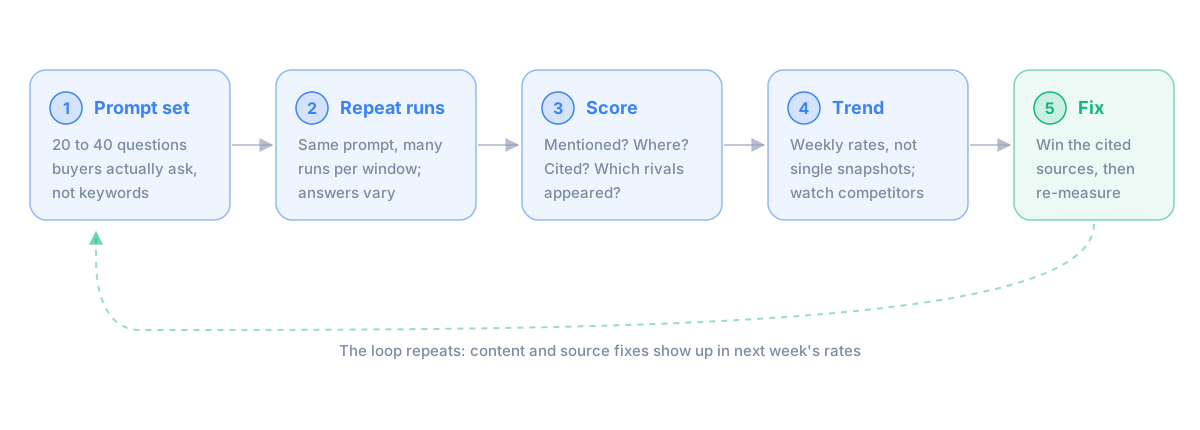
Step 1: Build a prompt set, not a keyword list
Track the questions buyers type, in full sentences: "best project management tool for a 10-person agency", not "project management software". Aim for 20 to 40 prompts spanning your money questions, comparison questions, and problem questions. Our walkthrough on finding the prompts your buyers ask AI shows where to mine them, and the free prompt generator drafts a starter set from your category.
Step 2: Run repeated samples
Run each prompt several times per measurement window, in fresh sessions so earlier turns do not contaminate answers. Memory, custom instructions, and account history personalize results, which is why your numbers will differ from a colleague's: their ChatGPT reports their history, not your market. Measure from a clean account, never your daily one.
Step 3: Score each run
For every run, record four things:
- Mentioned: yes or no
- Position: first recommendation, in the list, or afterthought
- Cited: did any source link point at your domain
- Competitors: which rivals appeared, and above or below you
If mentions are your main concern, the dedicated walkthrough on seeing and tracking brand mentions in ChatGPT goes deeper on scoring and sentiment.
Step 4: Trend weekly rates
A single week means little. Mention rate moving from 30% to 60% over six weeks after a content push means a lot. Weekly windows are the practical floor for spotting real movement; daily sampling earns its cost during launches and after model updates, when answers reshuffle fastest. Keep run counts next to every rate so you never mistake three lucky runs for a trend.
Step 5: Fix the sources, re-measure
When ChatGPT cites sources, those domains are the answer's supply chain. If review sites and comparison pages feed your category's answers and none of them mention you, that is your work queue. The loop then repeats: ship fixes, watch next week's rates.
What the manual version costs
The spreadsheet method works: 25 prompts times 5 runs is 125 fresh-session conversations per week, scored by hand across the four fields above. Expect three to four hours weekly, climbing as your prompt list grows, and it covers one engine. Do it for two weeks regardless of tooling; nothing builds intuition for how ChatGPT talks about your market faster.
To make the arithmetic concrete: suppose "best invoicing tool for freelancers" comes back mentioning you in 3 of 5 runs, once as the lead recommendation and twice mid-list, with your domain cited in 1 run and a competitor appearing in all 5. That row reads: mention rate 60%, average position middling, citation rate 20%, and a competitor with 100% presence. One week later the same prompt reads 4 of 5 with two lead positions. Neither week proves anything alone; six weeks of that trend after you shipped a comparison page is a result you can defend in a pipeline meeting. The interpretation logic for these numbers, which combinations mean "rented visibility" and which mean "cited but not recommended," is worked through in the AI rank trackers guide.
Tools that automate it
- Citlyze runs your prompt set repeatedly on a schedule, scores mentions, positions, and citations, tracks competitors on the same runs, and alerts you in Slack or Teams when your rate moves. ChatGPT is one of eight-plus tracked surfaces, from $29/month; the ChatGPT visibility tracker page shows the exact views. We build it, and the buyer's guide gives you the checklist to grill us with.
- Otterly.AI (from $29/month) and Rankscale (from $20/month) both track ChatGPT among other engines at budget prices, with lighter sampling and reporting.
- Enterprise programs gravitate to Profound (from $99/month, sales-led), where ChatGPT tracking comes wrapped in procurement-grade process.
Whichever you evaluate, confirm it captures search-mode answers and their cited-source lists, not just the text. Those source lists are the most actionable data in the whole exercise.
Free ChatGPT rank tracking
Fully free continuous tracking does not survive contact with compute costs, but three genuinely free moves cover a lot:
- The manual baseline audit above, run once: an afternoon, zero dollars, and you will know your starting mention rate.
- Our free tools for prompt research and crawler configuration, so GPTBot and OAI-SearchBot can reach your pages at all; OpenAI documents its crawlers here.
- A 14-day Citlyze trial, no card, which is long enough to get two real measurement windows on your own prompt set.
After two weeks of data
Run the manual protocol, or point a Citlyze trial at your prompt set, and two weeks from now you will know your ChatGPT mention rate, your average position, and which sources feed your category's answers. That baseline is what turns the rest of this guide from advice into a to-do list.