Perplexity Rank Tracking and Brand Monitoring (2026)
How to track your brand's citations and mentions in Perplexity answers, why Perplexity is the easiest engine to measure, and the tools that automate it.
 ChatGPT
 Claude
 Perplexity
 Grok
GrokOn this page
Perplexity is the easiest AI engine to track, because it shows its work. Every answer arrives with numbered source cards, so instead of guessing which pages fed a recommendation, you can read the supply chain directly. Perplexity rank tracking means running your buyer prompts repeatedly and recording three things per run: whether your brand is named, where in the answer it lands, and whether your domain appears among the cited sources.
Why Perplexity is the most measurable engine
We have a number for this. In our August 2026 answer study, 200 buyer-style prompts across 20 product categories were run once each through ChatGPT and Perplexity with web search enabled. Perplexity attached citations to 100% of its 200 answers, a mean of 9.9 sources per answer. ChatGPT cited on 39% of answers, averaging 1.5 sources. Across the same 200 prompts, Perplexity cited 569 distinct domains; ChatGPT cited 138.
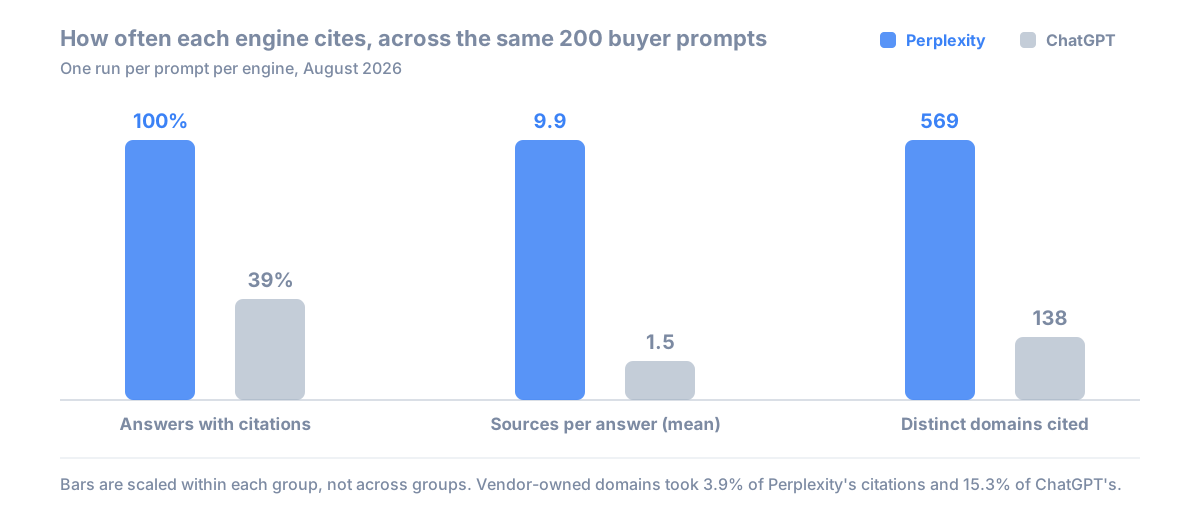
That density changes what tracking can tell you. On an engine that rarely cites, you learn whether you were mentioned. On Perplexity, you learn which ten pages the answer was assembled from, every single time, which turns a visibility report into a list of pages worth going after.
The second half of that study is the uncomfortable half. Only 3.9% of Perplexity's citations went to vendor-owned domains. The rest went to communities, reviews, and media: Reddit appeared in 77% of answers, YouTube in 68%, counting every source the API returned; the shares cited in the answer text were 13.5% and 20%, and the Q3 2026 citation index shows both near zero by late September. If you are trying to move your Perplexity numbers by publishing more pages on your own site, the data says you are working the smallest lever available.
The three numbers worth tracking
Mention rate. How often your brand is named across repeated runs of a prompt. Perplexity answers are short, a median of 227 words in our study, and named a median of three tracked brands per category. Three slots is the whole game.
Citation share. How often your domain appears in the source cards, as a share of the sources shown. This is the number that separates Perplexity from every other engine, because it is unambiguous: the URLs are right there.
Source ownership. Which domains keep showing up for your prompts whether or not you appear. That list is the real deliverable. If four of your money prompts consistently pull from the same three review roundups, those three pages are your quarter.
Position matters less here than on ChatGPT. Perplexity's answers are compact and list-shaped, so the gap between the first and third brand named is narrower than in a long conversational recommendation. Weight mentions and citations over ordering, and read our share of voice guide for how to score competitors on the same runs.
Tracking Perplexity by hand
The manual protocol takes a couple of hours and is worth running once even if you buy a tool the following week.
- Build 20 to 40 buyer prompts. Full questions, the way people type them into Perplexity: "best warehouse management software for a 30-person 3PL", not "warehouse software". Our walkthrough on finding the prompts your buyers ask AI covers where to mine them.
- Run each prompt five times, in fresh threads. Perplexity's follow-up model means earlier turns steer later answers, so start clean each time. Five runs per prompt is the floor at which a rate means anything.
- Record per run: brand named (yes/no), position in the answer, your domain present in sources (yes/no), plus every cited domain and every competitor named.
- Compute rates, not counts. Mentioned in 3 of 5 runs is a 60% mention rate. Note the run count next to it, always.
- Rank the cited domains by frequency. This is the output that changes your content plan.
Expect the citation list to be unstable. In the five-run variance subset of our answer study, which ran through ChatGPT, not a single prompt returned the same citation set twice, with a median overlap of 4.8% between same-prompt runs. Perplexity re-retrieves on every fresh thread, so plan for the same kind of churn. The domains that survive that churn are the ones that matter, which is exactly why single checks mislead and answers change between identical prompts.
Let PerplexityBot in first
Tracking measures a system you also have to be eligible for. Perplexity documents two user agents: PerplexityBot, which crawls to build the index behind its search results, and Perplexity-User, which fetches a page when a user's question sends it there. The first respects robots.txt; the second, per Perplexity's docs, generally does not, because it acts on a user request rather than a crawl.
Blocking PerplexityBot removes you from consideration entirely, and plenty of sites do it by accident through a blanket bot rule at the CDN. Check your robots.txt and your edge rules before you spend a quarter wondering why your citation share sits at zero. Our AI crawlers guide lists the agents worth allowing, and the crawl versus citation piece explains why being crawled is necessary but nowhere near sufficient.
Tools that track Perplexity
Perplexity coverage is close to universal in this category, so the question is not who tracks it but how deeply. Grade candidates on runs per prompt per window, whether the full source list is stored (not just your own domain), and whether competitors are scored on the same runs.
Citlyze
Citlyze samples Perplexity daily through its API, scores mentions and positions, and keeps the complete cited-source list per run, so the domain-frequency table above builds itself. Perplexity sits alongside seven other tracked surfaces on every plan from $29/month, with Slack and Teams alerts when a competitor takes your slot. The Perplexity brand monitoring page shows the views. We build it, so treat this entry as the interested one and check the source-list claim against the trial.
Rankscale
Rankscale covers Perplexity inside a ten-engine spread from $20/month, the cheapest continuous option we know of. Sampling depth is lighter, which for Perplexity specifically matters less than elsewhere: a cited answer carries information even at one run.
Otterly.AI
Otterly.AI starts at $29/month, and the constraint at that tier is quota rather than coverage: 15 tracked search prompts, with larger prompt banks on the $189 Standard tier. Fine for a focused prompt set, tight if you want the 40-prompt list this article recommends.
Profound
Profound reaches Perplexity on its $399/month Growth plan, not the $99 Starter tier, which covers ChatGPT only. Worth knowing before a demo: the entry price and the Perplexity price are different prices. Our Profound review goes through the ladder.
Free Perplexity rank tracking
There is no free tool that continuously tracks Perplexity, because every run costs someone an API call. What is genuinely free:
- The manual protocol above. Twenty prompts, five runs each, a few hours of work, and you have a baseline built entirely from your own prompts.
- Your server logs.
PerplexityBotandPerplexity-Userhits tell you which of your pages Perplexity reaches for, andPerplexity-Usertraffic in particular means a live answer sent someone to that URL. Our attribution guide covers separating that traffic from the rest. - Trials. Most tools here run 7 to 14 days, which is long enough for two measurement windows on a real prompt set if you set it up on day one.
Free tiers that offer a single instant check are worth one sitting of curiosity and no more. They answer "am I visible right now", which, on an engine where the citation set changes run to run, is the least reliable question you can ask.
Start with the source list
Whatever you use to collect it, the artifact that pays for this work is the ranked list of domains Perplexity cites for your prompts. Run twenty prompts, tally the sources, and you will have a page-by-page target list for the next quarter, plus a baseline citation share to measure it against. If you would rather not tally by hand, Citlyze builds that table from daily runs, and the buyer's guide has the questions to put to us and to everyone else on the shortlist.