What Is AEO? Answer Engine Optimization, Explained
AEO (answer engine optimization) is the practice of getting answer engines to use your content. What it covers and how it differs from SEO.
 ChatGPT
 Claude
 Perplexity
 Grok
GrokOn this page
Answer engine optimization (AEO) is the practice of getting AI answer engines to name, cite, and recommend your brand when people ask questions in your category. Where SEO competes for a position in a list of links, AEO competes for a place inside a composed answer. The engines are ChatGPT, Gemini, Perplexity, Google's AI Overviews and AI Mode, Microsoft Copilot, and the rest.
That is the definition. The rest of this page is what the work consists of, where it came from, and which parts of the standard advice are already out of date.
What "answer engine" means
An answer engine takes a question and returns a composed response rather than a ranked list. It does this in two modes, and the distinction runs through everything below.
Retrieval mode. The engine searches the live web, pulls a handful of pages, and writes an answer grounded in what it found, usually with citations. Perplexity works this way on effectively every query. ChatGPT does it when a question needs current information.
Memory mode. The engine answers from what the model already learned in training, with no live lookup and usually no citations. Ask "what are the best CRMs for small businesses" and a model may well answer entirely from priors.
Both modes decide whether your brand gets named. They respond to different work, which is why AEO is not a single tactic. Retrieval rewards pages that are crawlable, extractable, and cited by others. Memory rewards being written about, consistently, across the corpus the model trained on.
Where AEO came from
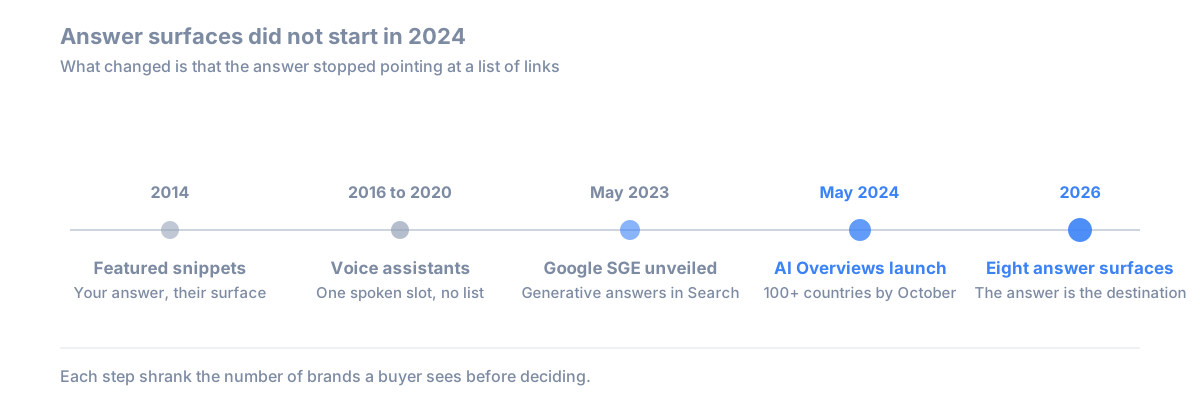
AEO is a continuation, not an invention. Google introduced featured snippets in January 2014, and with them the first real version of the modern problem: your content answers the question, on someone else's surface, sometimes without a click. Voice assistants pushed it further, because a spoken answer has exactly one slot.
The step change came in two moves. Google unveiled the Search Generative Experience at I/O in May 2023, then launched AI Overviews in the US at I/O 2024 and expanded them past 100 countries that October. In parallel, assistants became a search habit in their own right.
The practical consequence: the answer is now the destination for a large share of question-shaped queries, and there are perhaps eight surfaces composing them instead of one page ranking ten links. The numbers behind that shift, from Pew, SparkToro, and Gartner, are collected in our AI search statistics roundup.
How an answer engine picks its sources
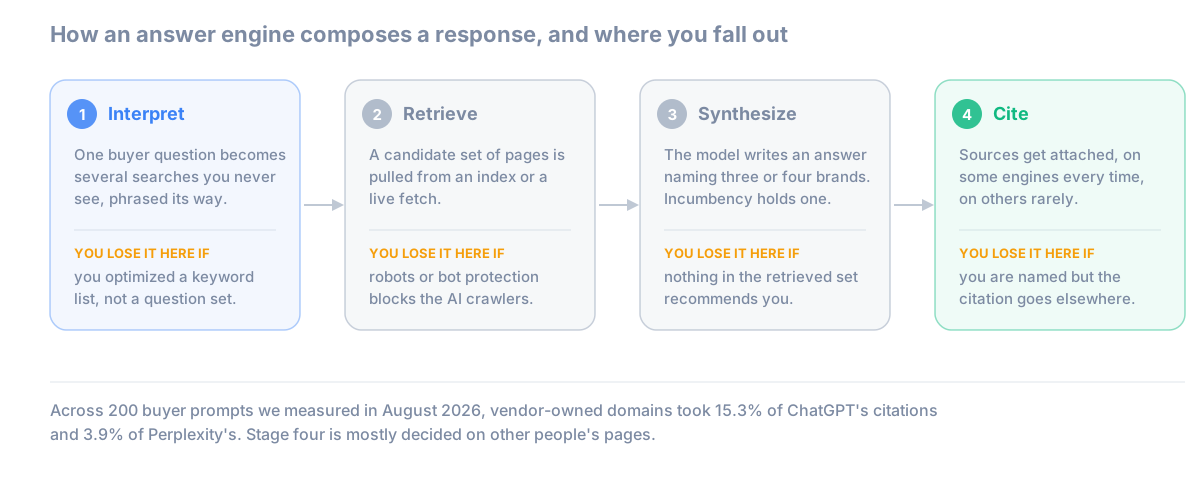
Every engine differs in detail, but the shape is consistent, and each stage is a distinct failure point.
1. Interpret and fan out. The engine rewrites your buyer's question into one or several searches. A single prompt like "best expense tool for a 40-person agency" can become half a dozen queries. You never see them, and they rarely match your keyword list.
2. Retrieve a candidate set. Pages get pulled from an index. If AI crawlers cannot reach your site, this is where you disappear, and it is more common than teams expect. Our AI crawlers guide covers which user agents matter and what blocking each one costs you.
3. Synthesize. The model writes an answer, naming a small number of brands. In our August 2026 study of 200 buyer prompts, answers named a median of three to four tracked brands per category, and the category leader appeared in 86% of ChatGPT answers. Three slots, and incumbency already holds one.
4. Cite. The engine attaches sources, sometimes. Citation is a separate event from being named, and the two come apart constantly: you can be recommended without your domain being cited, or cited for a fact while a competitor gets the recommendation. That gap is worked through in crawl versus citation.
The most useful finding from that study concerns whose pages fill stage four. Vendor-owned domains took 15.3% of ChatGPT's citations and 3.9% of Perplexity's. Everything else went to reviews, communities, and media. AEO is therefore only partly about your website, which is the single most common misunderstanding in the field.
The engines, and how they differ
"Answer engine" covers surfaces that behave differently enough that a single strategy optimizes for none of them. The strongest evidence we have for that is our own: across 200 buyer prompts run through ChatGPT and Perplexity, the two engines cited zero overlapping domains on 77% of prompts. Winning one tells you almost nothing about the other.
ChatGPT is the largest by user base and the most conversational. It answers from memory often, searches when the question demands currency, and cites sparingly: 39% of answers in our study carried any citation, averaging 1.5 sources. When it does cite, it reaches for tech and business media. What feeds it is covered in how ChatGPT picks its sources.
Perplexity is the opposite and the easiest to measure. It cited sources on 100% of answers, averaging 9.9 per answer, drawing heavily on Reddit (77% of answers) and YouTube (68%). If you want to see the supply chain behind your category's recommendations, this is where to look first. See Perplexity rank tracking.
Google AI Overviews and AI Mode behave like search features rather than chatbots. Presence is conditional, citation slots are limited, and the underlying retrieval is Google's index, which means your existing SEO work carries furthest here. Covered in optimizing for AI Overviews and AI Mode.
Microsoft Copilot rides the Bing index, which makes Bing hygiene the eligibility layer, and it is the only engine where the vendor reports your citations back to you for free through Bing Webmaster Tools. See Copilot rank tracking.
Gemini, DeepSeek, Grok, and the rest matter to different degrees by market and audience. Gemini rides Google's index with no crawler of its own, Grok listens to the live X conversation, and tracking your brand in DeepSeek is pure prompt sampling. Coverage beyond the engines your buyers actually use adds nothing you can act on, and picking the right subset is a real decision rather than a maximization problem.
The practical consequence of that 77% figure: audit per engine, not in aggregate. A blended "AI visibility score" averages away the only information that tells you what to do next. Tactics per surface, ranked, are in AI search optimization.
What Google says you need to do
Nothing special, according to Google. Its documentation for AI features states there are no additional requirements to appear in AI Overviews or AI Mode and no special optimizations necessary, and adds that you do not need to create new machine-readable files, AI text files, or markup for these features. Standard indexability and helpful content are the stated requirements.
We sell AI visibility software and we think that guidance is broadly correct, at least for Google's surfaces. It is worth quoting precisely because so much AEO advice sells the opposite: a new file, a new schema, a new checklist that Google explicitly says it does not read.
What Google's position does not cover is the other half of the problem. Its documentation describes eligibility on Google's own surfaces. It says nothing about how ChatGPT weighs a Reddit thread, why Perplexity leans on YouTube, or which review sites shape your category's consideration set. And it offers no measurement: Search Console folds AI feature traffic into web search totals rather than reporting mention or citation rates. The work AEO adds on top of good SEO is largely off-site influence and measurement, not secret markup.
AEO, GEO, and SEO
GEO (generative engine optimization) is the same discipline under a different name, coined by the 2023 research paper that first measured content-side changes against generative engines. Practitioners use the terms interchangeably, and so do we. Our AEO vs GEO piece covers why two names exist.
SEO is the discipline AEO sits on top of. Crawlability, site quality, authority, and topical depth all feed retrieval, which is why "do AEO instead of SEO" is bad advice. What genuinely changes is the success metric, the content shape, and the measurement method, and AEO vs SEO works through each of those in practical detail.
The short version: one strategy, two scoreboards.
What AEO work actually consists of
Five workstreams, in the order they usually pay off.
1. Know the prompts
AEO starts from questions, not keywords. Your buyers type full sentences into these tools, and a prompt set of 20 to 40 real buyer questions is the unit of work that everything else measures against. Building that list is covered in finding the prompts your buyers ask AI.
2. Make pages answerable
Answer engines lift passages. Pages built as one long argument with the conclusion at the bottom extract badly; pages with question-shaped headings and a direct 40 to 60 word answer underneath extract well. That is the entire structural idea, and AEO website structure turns it into a page-anatomy checklist with the current schema advice attached.
3. Fix eligibility
Robots rules, CDN bot protection, and rendering all decide whether stage two can see you. This is unglamorous, cheap, and the most common cause of a flat zero. The GEO audit guide is the checklist we use.
4. Earn third-party presence
Given that most citations point somewhere other than your domain, the highest-leverage work is often getting accurate, favourable coverage on the pages that already feed your category's answers: review platforms, comparison roundups, community threads, trade press. You find those pages by reading the citation lists your tracking produces, then treating them as an outreach and content queue.
5. Measure, then repeat
Identical prompts return different answers, so a single check is a sample rather than a result. In our variance subset, only 68.8% of brands that appeared in at least one run appeared in all five runs of the same prompt. Rates over repeated runs are the only honest unit, a point covered in why AI answers change.
The full ordered playbook, with what to do in each step, is how to do AEO.
How you know it is working
AEO has its own metrics, and none of them come out of a rank tracker.
- Mention rate. Across repeated runs of a prompt, how often the answer names your brand. The headline number.
- Citation rate or share. How often your domain appears among the cited sources. Benchmarks and what counts as good are in what is a good AI citation rate.
- Share of voice. Your mentions against named competitors on the same runs, which is the context that makes a mention rate mean anything. See AI share of voice.
- Sentiment and accuracy. Whether the description is correct and favourable. A confidently wrong answer about your pricing is a visibility problem too.
- Position within the answer. First recommendation versus fifth in a list of also-rans.
Every one of these needs a run count attached. A mention rate that arrives without the number of runs behind it should not make it into a report.
Who owns AEO
In most companies it lands on the SEO or organic team, and that is the right home: the skills transfer, the tooling budget already exists, and eligibility work is squarely theirs. But three of the five workstreams above reach outside that team, which is why AEO programs stall when they are treated as one person's side project.
Content owns the page shape. Rewriting for extraction is an editorial standards change, not a one-off project, and it holds only if the house style changes with it.
PR and partnerships own the third-party layer. Getting into the roundups, review platforms, and community threads that fill citation slots is outreach work. When the SEO team owns the measurement but nobody owns the outreach, the citation list becomes a report nobody acts on.
Product marketing owns entity consistency. One canonical description of what you sell, used everywhere, is a positioning decision before it is an optimization.
The practical arrangement that works: one owner for the measurement and the prompt set, a standing queue fed by the citation data, and named owners for the page-shape and outreach halves. AEO in marketing is less a new channel than a new input feeding three existing ones.
How long it takes
Expect different clocks for different work, and set expectations accordingly before anyone commits to a quarter.
Eligibility fixes: days. Unblock a crawler and the effect shows up as soon as the engine next fetches you. This is the only part of AEO that is fast.
Page structure: one to two measurement windows. Rewriting a page answer-first can change whether it gets extracted within a couple of weeks, assuming the page was already being retrieved.
Third-party presence: quarters. Getting added to a roundup takes as long as outreach takes, and the answer only moves once the engine re-crawls that page and the change survives its ranking of sources.
Memory-mode answers: longer, and partly outside your control. What a model says without searching reflects the corpus it trained on. Sustained third-party presence is the only real lever, and the payoff lands with the next model, not this one.
Anyone promising a mention-rate jump in thirty days is quoting the eligibility timescale for work that actually moves in quarters.
What does not work
Three things get sold as AEO and do not survive contact with evidence.
FAQ schema for rich results. This advice is now simply out of date. Google restricted FAQ rich results to authoritative government and health sites in August 2023, then removed the feature entirely: FAQ rich results stopped appearing in Google Search on 7 May 2026, and the documentation was withdrawn. Existing markup is harmless and FAQPage remains a valid schema.org type, but any 2026 guide promising rich results from it is describing a feature that no longer exists.
llms.txt as a visibility lever. Cheap, harmless, and still unproven: no major engine has documented consuming it. We looked at the evidence in does llms.txt work. Ship it if you like, but not before the five workstreams above.
Keyword density, in any form. Engines synthesize meaning from passages. The GEO paper measured visibility gains of up to 40% from content changes, and the changes that worked were citations, quotations, and statistics, not repetition.
A fourth item belongs here with a caveat: writing pages aimed at machines rather than people. It works briefly and ages badly, and it is the tactic most likely to be penalized by whatever comes next.
Where to start this week
Pick your ten most commercial buyer questions and run each one five times through ChatGPT and Perplexity in fresh sessions. Record whether you are named, who else is, and which domains get cited. That afternoon produces three things: a baseline mention rate, a list of competitors the engines prefer, and a ranked list of the third-party pages shaping your category. Those are the inputs to every other decision in AEO, and none of them are in your analytics.
Doing that by hand holds up until roughly forty prompts across several engines, which is where tooling starts to earn its cost; what that cost actually looks like, from software tiers to agency retainers, is in how much AEO costs. Our AEO tools comparison covers that market honestly, including where competitors beat us, and the answer engine optimization tool page shows how we approach it.
Take the manual baseline first regardless. It is the only number in this field that nobody sold you.