How Much Does AEO Cost in 2026? Real Numbers
What AEO actually costs: DIY time, software from $20 a month, agency retainers from $3,000, and how to decide which tier you need.
 ChatGPT
 Claude
 Perplexity
 Grok
GrokOn this page
Answer engine optimization costs either time or money, and the exchange rate is unusually clear. Doing it yourself costs six to eight hours a week and nothing else. Software that automates the measurement runs $20 to $800 a month depending on prompt volume and engine coverage. Agencies that publish their rates start around $3,000 a month, with full programs at $10,000. Most agencies do not publish anything.
That last sentence is the honest headline of this page. Software pricing in this category is transparent and verifiable. Service pricing largely is not, and the ranges circulating in agency "pricing guides" are self-reported and unsourced. What follows separates the two.
The three ways to buy
1. Do it yourself: hours, not dollars
The manual protocol is genuinely free and genuinely expensive. Twenty-five prompts run five times each is 125 fresh-session conversations per measurement window, each scored for mention, position, citation, and competitors. On one engine that is three to four hours a week. On two it is closer to eight.
Add the work the measurement points at: rewriting pages answer-first, chasing third-party listings, keeping entity descriptions consistent. A realistic DIY program is a day a week of someone's time, indefinitely.
Whether that is cheap depends entirely on whose day it is. Apply your own loaded hourly rate rather than a number from an article, and compare the result to the software tier below before deciding you are saving money. For most teams the arithmetic stops being favourable somewhere past twenty prompts on two engines, which is also roughly where the manual method stops being reliable, because the run counts get cut to fit the hours available.
The AEO playbook is the DIY version written out, and it is worth doing manually for two weeks regardless of what you buy afterwards. Nothing else builds the same intuition for how engines talk about your market.
2. Software: $20 to $800 a month
This is the transparent tier. Every figure below came off the vendor's own pricing page in August 2026, and you can check each one in a minute.
| Tool | From | What the entry tier buys |
|---|---|---|
| Rankscale | $20/mo | The longest engine list at the lowest price, thin reporting |
| Citlyze | $29/mo | 5 daily prompts, 8 answer surfaces on every plan |
| Otterly.AI | $29/mo | 15 tracked prompts; extra markets take extra slots |
| Profound | $99/mo | ChatGPT only, 50 prompts, 1 seat |
| Scrunch | $250/mo annual | 350 custom prompts, 3 seats, page audits |
| Athena | $295/mo | Credit-based across nine models, plus a small free tier |
| Evertune | $800/mo | Category-scale brand measurement at very high prompt volumes |
Two things move you up this ladder, and neither is quality of measurement. The first is prompt volume: entry tiers assume one product line and one market, and multi-market tracking multiplies the count because most vendors charge per prompt per market. The second is engine coverage, where the gap between "ChatGPT" and "the engines your buyers actually use" can be a factor of four in price.
What you get is the same fundamental capability at every tier: repeated sampling of your prompts with rates computed over the runs. What the higher tiers add is seats, reporting, audits, and process. Our AEO tools comparison grades the category on both halves, and how to choose an AI visibility tool is the checklist to grill any of them with.
Budget the tool at the size of your real prompt set, not the sticker price. A $29 plan you outgrow in six weeks is more expensive than the $99 plan you keep.
3. Agencies: what is actually published
Here the market gets opaque, so treat the following as the small verifiable part of a mostly unverifiable picture.
RevenueZen publishes a full ladder: $3,000 a month for its Foundation package, rising through $5,000, $7,000, $10,000 and $15,000 tiers. The detail that matters for AEO buyers is where the AI work sits. Generative engine topic research appears at the $5,000 tier, and a full GEO program with quarterly audits and citation optimization appears at $10,000. RevvGrowth publishes a $3,000 a month B2B SaaS package built around ten AEO-structured posts per month plus schema and entity work.
So among agencies that publish, the entry point clusters around $3,000 a month, and a genuinely full AEO program lands near $10,000. Those are two data points, not a market.
The larger fact is that most agencies publish nothing. Well-known content and SEO shops that now sell AEO work almost all require a discovery call before any number appears. That is a normal enterprise sales motion rather than a scandal, but it has a practical consequence: the "typical AEO agency costs $X" ranges you will find are assembled from self-reported estimates with no sourcing behind them. We are not going to repeat them as fact.
Two sanity checks when you do get a quote. Ask what fraction of the retainer is measurement versus production, because measurement you can buy for $29 to $250 a month and should not pay a retainer multiple for. And ask what the deliverable is in a month where nothing moves, since AI visibility work has quarters where the honest answer is "we shipped the fixes and the numbers have not turned yet."
What each budget level actually buys
| Monthly budget | What it covers | What it will not cover |
|---|---|---|
| $0 | Manual sampling on a small prompt set, eligibility fixes, Bing Webmaster Tools citation data | Trends across many prompts, competitor tracking at scale, anyone else's time |
| $20 to $100 | Automated tracking on 5 to 50 prompts, multiple engines, competitor share of voice | Content production, outreach, anyone to interpret it |
| $100 to $500 | Larger prompt sets, multiple markets, seats for a team, audits and reporting | The writing and the outreach, still yours |
| $3,000+ | An agency doing production and outreach against the measurement | Nothing automatic. Ask exactly which of the above they replace |
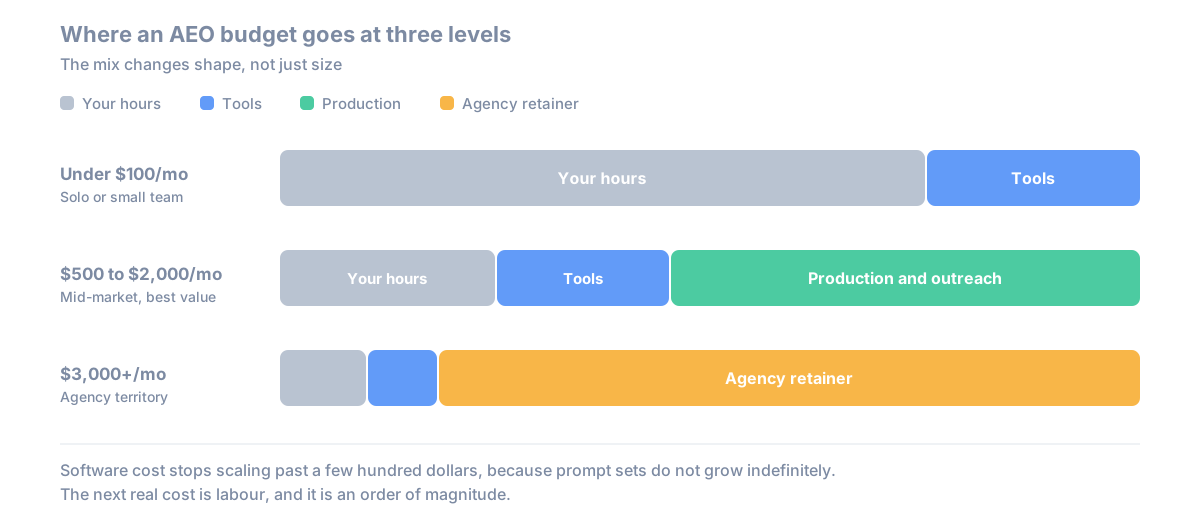
The transition that catches teams out is the third row to the fourth. Software costs stop scaling meaningfully past a few hundred dollars for most companies, because prompt sets do not grow indefinitely. The next real cost is labour, and it is an order of magnitude.
Splitting a budget by company size
Three defensible allocations, assuming AEO is additive to whatever SEO you already run.
Solo operator or a small team, under $100 a month. One tracking tool at the entry tier, everything else your own hours, with free AI SEO tools covering the structural and research work at zero cost. Spend the hours on the two highest-leverage items rather than volume: making your five most commercial pages answer-first, and getting into the third-party roundups your citation list keeps surfacing. Free first-party data helps here more than people expect, since Bing Webmaster Tools reports your actual Copilot citations at no cost, as covered in Copilot rank tracking.
Mid-market, $500 to $2,000 a month. Tracking at a tier that covers your real prompt set and markets, plus freelance or in-house production against what the measurement points at. This is usually the best value in the whole range, because you are paying for the work rather than for the account management around it.
Enterprise, $3,000 and up. Agency or specialist headcount becomes rational once the queue is bigger than the team, particularly the third-party outreach half, which depends on relationships and sits at the bottom of every in-house priority list. Which agencies do this work, and which of them publish rates, is in best AI SEO agencies. Keep the measurement tool separate from the agency doing the work. An agency that scores its own output leaves you with no independent check on the retainer.
What not to pay for
Guaranteed rankings or mentions. No engine sells placement inside organic answers, and generation is probabilistic. Anyone promising a mention rate is either misunderstanding the mechanism or counting on you to.
Schema packages sold as an AI visibility lever. Structured data is worth shipping for entity clarity, but Google's own AI features documentation says no special markup is needed for AI Overviews or AI Mode, and FAQ rich results were retired in May 2026. Pricing a retainer around markup is pricing around a dead lever. Details in AEO website structure.
Fast results. Eligibility fixes land in days, page restructuring in a window or two, third-party presence in quarters. A thirty-day turnaround promise is describing the cheapest bucket and charging for the slowest one.
The cheapest useful next step
Take the manual baseline before you buy anything. Ten commercial prompts, five runs each, one afternoon, zero dollars. You will end up with your current mention rate, the competitors the engines prefer, and the list of third-party pages shaping your category.
That baseline is what turns every quote you receive into a comparison rather than a leap of faith, because you will know what the work is meant to move. The AEO pillar covers what the discipline is before you spend anything on it.