AEO vs SEO: What Actually Changes (2026)
AEO and SEO share foundations but reward different things. What transfers from your SEO program, what does not, and how to split effort this quarter.
 ChatGPT
 Claude
 Perplexity
 Grok
GrokOn this page
Most of your SEO program transfers to AEO. Crawlability, topical depth, and genuinely useful content all feed the retrieval step that answer engines depend on. Three things do not transfer: the success metric, the measurement method, and the assumption that the work happens on your own domain. Those three are the whole difference, and they are enough to make an SEO-only team invisible in the answers their buyers read.
What transfers, on a gradient
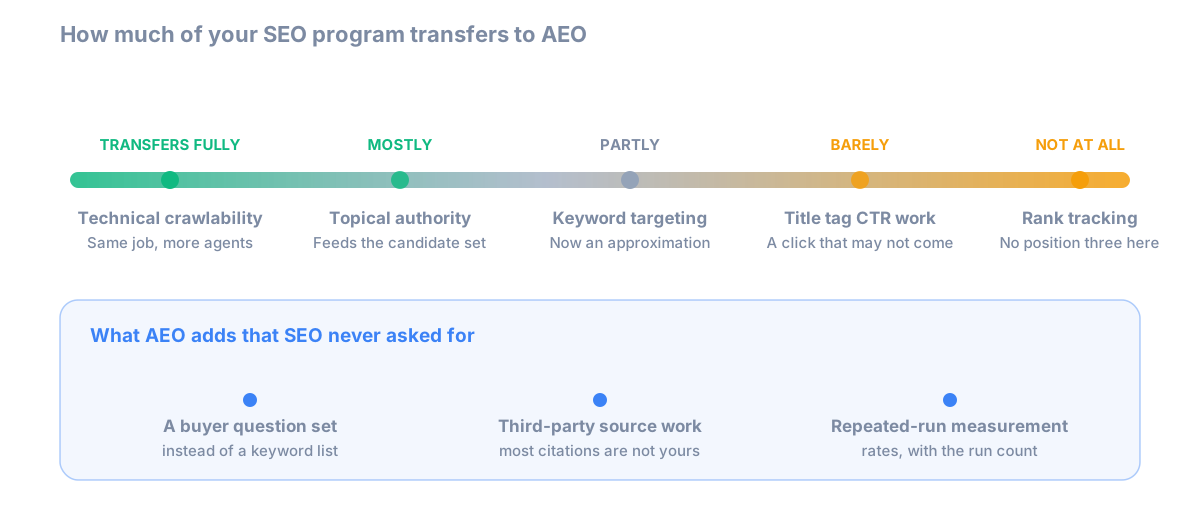
Fully. Technical crawlability is the same discipline with a longer list of user agents. If GPTBot, OAI-SearchBot, and PerplexityBot cannot fetch the page, nothing downstream matters, and the most common cause is a blanket bot rule at the CDN rather than anything in robots.txt. Our AI crawlers guide covers the inventory.
Mostly. Topical authority and depth carry over well. Engines retrieve from indexes built on much the same signals your rankings depend on, so a site that ranks broadly in its category tends to enter more candidate sets. Comparison and alternatives content transfers particularly well, because those pages answer the exact question shape buyers bring to assistants.
Partly. Keyword targeting still helps you get retrieved, but it stops being the unit of work. Engines rewrite one buyer question into several searches you never see, so a keyword list is an approximation of demand rather than a description of it.
Barely. Title tag and meta description craft is optimization for a click decision that increasingly does not happen. Write them well for search; expect nothing from them in an answer.
Not at all. Rank tracking. There is no position three in a composed answer, and a rank report cannot tell you whether ChatGPT recommends you. This is the gap that created the AI visibility tooling category, and best rank trackers covers which classic tools have tried to close it.
The three real differences
The success metric changes from position to rate
A keyword either ranks third or it does not, and the number is stable enough to report weekly. An AI answer changes between runs of the identical prompt. In our August 2026 study, we ran 30 prompts five times each through ChatGPT: only 68.8% of brands that appeared in at least one run appeared in all five, and not one prompt returned the same citation list twice.
So AEO's headline number is a rate measured over repeated runs. Mention rate, citation rate, share of voice. Every one of them is meaningless without the run count attached, which is the single most useful question to ask any vendor.
The content shape changes from argument to passage
SEO rewards a page that satisfies a searcher who has already clicked. AEO rewards a page an engine can lift a passage from without reading the whole thing.
In practice that means question-shaped headings, a direct 40 to 60 word answer immediately under each one, and the conclusion near the top rather than earned at the bottom. It is closer to writing reference documentation than to writing an essay. The full page anatomy is in AEO website structure.
The work moves off your domain
This is the difference teams find hardest, and the one with the best evidence behind it. Across 200 buyer prompts, vendor-owned domains took 15.3% of ChatGPT's citations and 3.9% of Perplexity's. The remainder went to reviews, communities, comparison roundups, and media.
Read that against how SEO works. In search, publishing a better page on your domain is the primary lever. In AEO, publishing a better page on your domain is one lever among several, and often not the biggest. The engines are largely repeating what other people's pages say about your category, so the work becomes influencing those pages: getting listed accurately in the roundups that feed your answers, showing up in the community threads, correcting stale third-party descriptions.
Side by side
| SEO | AEO | |
|---|---|---|
| Unit of success | Position for a keyword | Mention or citation in an answer |
| Measurement | Deterministic rank check | Repeated runs, rates with run counts |
| Surfaces | One dominant engine | Eight or more, none with a rulebook |
| Demand input | Keyword list | Buyer question set |
| Content shape | Full page satisfying a click | Extractable passage under a question |
| Primary lever | Your domain | Your domain plus the sources about you |
| Payoff | A click | Influence, often with no click |
| Guidelines | Published and detailed | Mostly absent |
That last row deserves a caveat, because Google is the exception. Its AI features documentation states there are no additional requirements to appear in AI Overviews or AI Mode and no special optimizations necessary, and that you do not need new machine-readable files or markup. For Google's surfaces, good SEO genuinely is the stated path. What Google's guidance does not address is the assistants, where its writ does not run, or measurement, which Search Console does not provide.
Why ranking first is not enough
The uncomfortable pattern: brands that rank first for their category term regularly go unmentioned when an assistant answers the same question. Three mechanisms explain it, and they are worth knowing separately because they need different fixes.
Retrieval never saw you. Bot rules, JavaScript rendering, or an index the engine does not use. A technical fix, and the cheapest one available.
Retrieval saw you and the model chose others. Your page was in the candidate set, but the sources that shape recommendations, the roundups and threads, do not name you. An off-site content and outreach problem.
The model answered from memory. No live retrieval happened at all, and the answer came from priors formed on a corpus that predates your best work. The slowest to fix and the most dependent on sustained third-party presence.
Rank data cannot distinguish these three. Mention rate plus citation share plus the cited-domain list can, which is the practical argument for measuring the answer layer separately rather than assuming rankings proxy for it.
Splitting effort this quarter
A rough allocation for a team starting from a working SEO program:
- One week on eligibility. Audit crawler access, rendering, and robots rules. Cheap, fast, and it occasionally explains everything. Checklist in the GEO audit guide.
- One week on measurement. Build a 20 to 40 prompt buyer question set and get a baseline. Manual is fine to start; finding buyer prompts covers assembling the list.
- The rest on the two things the baseline points at. Usually some mix of restructuring your highest-intent pages for extraction and going after the third-party sources your citation list keeps surfacing.
What that ordering deliberately avoids is a content sprint before measurement. Without a baseline, you will not know which of the three failure mechanisms above you have, and the three call for entirely different work.
The honest summary
AEO is not a replacement discipline, and the teams selling it as one are overselling. It is your existing SEO program plus a second scoreboard and a shift in where the marginal effort goes.
Our AEO pillar covers the discipline end to end, how to do AEO is the ordered playbook, and if the acronym soup is the confusing part, AEO vs GEO explains why the same work has two names. The AI SEO guide sits above all of them, covering both this and the other thing people mean by AI SEO. Building the second scoreboard is what Citlyze exists to do.
Keep ranking. Then find out whether ranking is buying you anything in the answers.