Best AI SEO Tools in 2026 (By Job, Not Hype)
The AI SEO tools worth paying for in 2026, organized by job: AI visibility tracking, content optimization, technical crawling, and free tools.
 ChatGPT
 Claude
 Perplexity
 Grok
GrokOn this page
"AI SEO tools" now covers four unrelated jobs, and most buying mistakes come from confusing them. The term itself splits two ways before you even reach tooling, which is untangled in the AI SEO guide. Tracking whether ChatGPT recommends your brand, drafting content faster, optimizing a page against competitors, and crawling a site with an LLM attached are four different products, and no single tool leads at all four. This list is organized by job, with real August 2026 pricing, so you can buy the one you actually need: Citlyze, Profound, Otterly.AI, or Rankscale for visibility tracking; Surfer, Clearscope, or Frase for content; Semrush or Ahrefs on the suite side; Screaming Frog for crawling.
We build Citlyze, which appears under the first job. Every price below links to the vendor's own pricing page, and there are no affiliate links anywhere on this site.
The four jobs
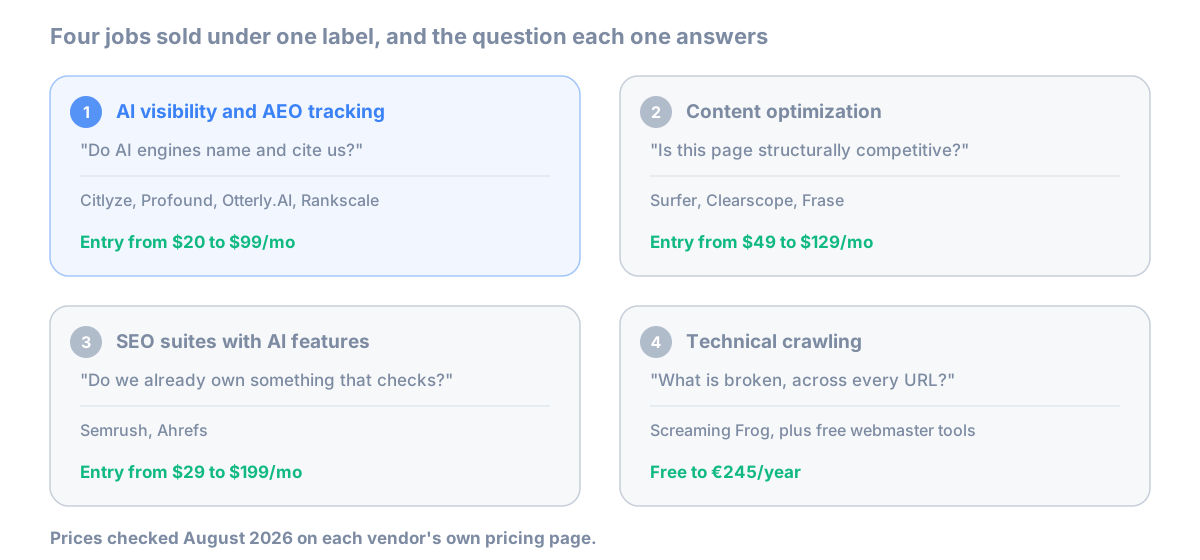
Job 1: measure whether AI engines recommend you. Prompt tracking, mention rates, citation share. Job 2: optimize a page against what already ranks or gets cited. Content briefs, coverage scoring. Job 3: run classic SEO with AI bolted on. Keyword and backlink suites that added prompt tracking. Job 4: crawl and audit at scale. Technical work, now with LLM calls available mid-crawl.
If a tool claims all four, read its pricing page and find out which one it charges for.
Job 1: AI visibility and AEO tracking
The newest category and the one with the widest price spread, from $20 to five figures a month for what is nominally the same measurement. The deciding variables are engines covered, prompts allowed, and how many times each prompt runs per window.
Citlyze
From $29/month, covering ChatGPT, Gemini, Perplexity, DeepSeek, and ByteDance daily, plus weekly checks on Google AI Overviews, Google AI Mode, and Bing Copilot. Those eight surfaces are on every plan (Grok is a higher-tier addition), and every rate ships with the run count behind it. The entry plan is five daily prompts, which is the honest constraint: it is a real measurement on a small prompt set rather than a large prompt set measured once. No Claude tracking, and nothing resembling a keyword database. We build it, so weigh accordingly and read the buyer's guide before shortlisting anyone.
Profound
From $99/month, and the job-to-price mapping needs care: the $99 tier does job 1 on ChatGPT only, with 50 prompts. Three engines starts at $399, and the nine-engine coverage in the marketing means the Enterprise tier and a sales process. Worth the process for its real-user prompt demand data, which nobody else sells. Detail in our Profound review.
Otterly.AI
From $29/month, the cheapest genuine entry point in the category: 15 tracked prompts, rising to $189 for 100. Watch the geography, because a prompt belongs to one country, and a brand selling into three markets needs three slots per question.
Rankscale
$20/month buys more engines here than anything else on this page, Claude included. What you give up is the layer around the numbers: reporting is sparser than the tools above, which is the trade at that price.
Deeper comparisons live in best AI visibility tools and best AEO tools; for engine-specific tracking, see the roundups for AI rank trackers and AI Overviews trackers.
Job 2: content optimization
This category predates AI search and adapted to it. All three of these now bolt prompt tracking onto a content workflow, and none of them is a substitute for a dedicated visibility tool at scale. What they are good at is the page itself.
Surfer
From $49/month for Discovery, with AI prompt tracking arriving at $99 (25 prompts, weekly refresh) and $182 (50 prompts, daily). There is also a standalone AI Search Analytics product at $158/month for 100 prompts. Surfer's content editor remains the fastest way to take a draft from "written" to "structurally competitive", and structure is exactly what answer engines extract.
Clearscope
From $129/month for Essentials, including 50 tracked prompts and 50 pages, with Business at $399. Clearscope has always aimed at editorial teams that care about term coverage and readability rather than volume, and its query fan-out view (the web searches an AI runs while composing an answer) is a genuinely useful addition for anyone working on AI Mode visibility.
Frase
From $49/month monthly for Starter, $129 for Professional. Frase leans hardest into generation and publishing workflow, with direct publishing to WordPress, Webflow, and others. Best fit when the bottleneck is production volume rather than page quality, which is a real situation and also the easiest way to build a site nobody cites.
Job 3: SEO suites that added AI tracking
The relevant question here is rarely "is this the best AI tool". It is "do I already pay for this". Marginal cost changes the answer.
Semrush
Plans start at $139/month for SEO, with AI visibility tracking bundled from the $199 Starter tier upward: 50 prompts tracked daily on Starter, 100 on Pro+ at $299, 200 on Advanced at $549. If Semrush is already your keyword and backlink stack, the AI tracking is effectively free-standing budget you have already spent, and it is competent enough to answer "are we visible at all" before anyone buys a specialist tool.
Ahrefs
Plans run from $29/month for Starter through $129 Lite, $249 Standard, and $449 Advanced, with Brand Radar included and AI prompt tracking allocated per tier: 5 tracked prompts on Lite, 10 on Standard, 20 on Advanced. Continuous tracking at any real volume means a standalone Brand Radar subscription, priced in the several-hundred-per-month range depending on how many platforms you select. Ahrefs' distinctive asset is the size of its prompt research database rather than the tracking allowance, which is small by category standards.
The pattern in both: AI tracking is a feature that sells suite upgrades, sized accordingly. Ten tracked prompts will not measure a product line. That is not a criticism of either tool, it is a reason to know which job you are buying for.
Job 4: technical crawling
Screaming Frog
€245 per year for a licence, free up to 500 URLs, and it now crawls with OpenAI and Gemini available mid-crawl, which turns a site audit into a bulk classification job: extract every H1, ask a model whether each page answers its own title question, export the failures. For teams working through AEO structure fixes across a large site, this is the cheapest leverage on the list by a wide margin.
Free AI SEO tools that hold up
The first two are better than most paid products at their specific job, because they come from the source.
- Google Search Console. Still the only first-party record of what Google shows and what gets clicked. AI Overview impressions are folded into web search data rather than split out, which is a real limitation and not a reason to skip it.
- Bing Webmaster Tools AI Performance. Free, and the only place anyone reports your actual citations inside Microsoft Copilot: citation counts, per-URL detail, grounding query samples, and citation share, expanded in June 2026. Our Copilot tracking guide covers how to read it.
- Screaming Frog free tier. 500 URLs covers most small sites entirely.
- Trials, used properly. Two weeks on one prompt set across two tools tells you more than any comparison article, this one included.
The longer list, restricted to tools that are free indefinitely rather than free for fourteen days, is in free AI SEO tools.
Picks for creators and solo operators
A creator running one site does not need the stack above, and the sequence matters more than the tools. In order of what earns its cost first:
- Search Console and Bing Webmaster Tools. Free, and Bing's AI Performance report gives a solo publisher citation data that enterprise buyers pay for elsewhere.
- Screaming Frog free, or Ahrefs Starter at $29. Whichever of "fix the site" or "find the topics" is your current bottleneck.
- One content tool, not three. Surfer Discovery at $49 or Frase Starter at $49. Both will improve a draft; neither will improve a bad topic choice.
- One visibility tracker, once you have something to track. Any of the $20 to $29 entry tiers. Five to fifteen prompts is enough when you sell one thing.
The trap for creators is buying job-2 and job-3 tools while the actual bottleneck is job 1: nobody knows whether AI answers name you, so nobody knows which pages matter. That check costs a few hours by hand, and our guide to finding buyer prompts is where to start.
How to sequence the spend
Software is one line of a bigger budget, and how much AEO costs sets it against the DIY and agency alternatives with published numbers. Buy in the order the questions arrive. First, are we visible in AI answers at all, which is a job-1 question and answerable free by hand or cheaply on a trial. Second, which pages and sources are shaping those answers, which is where citation data earns a subscription. Third, fix the pages, which is job 2 and job 4 territory. Only then does a suite upgrade make sense, and by then you will know exactly which prompts you need tracked.
Whatever you shortlist, let your own prompt set have the final vote. Trials exist so a tool can be graded on your buyer questions rather than a demo account's, run counts included. Citlyze is glad to sit that exam, and if a rival reads better on your prompts, believe your prompts over any roundup, this one first.