The Future of SEO: What Survives AI Search
A data-backed argument for what happens to SEO as AI answers absorb queries: what survives, what dies, and what replaces rankings as the scoreboard.
 ChatGPT
 Claude
 Perplexity
 Grok
GrokOn this page
SEO is not dying. It is splitting into two disciplines that will need different teams within about three years: one that earns clicks on transactional queries, and one that earns citations inside answers on everything else. The first looks almost exactly like the SEO of 2019. The second has no established playbook, no shared benchmarks, and no agreed unit of success.
The reason to be specific rather than reassuring is that the two halves are diverging on evidence, not on vibes. Here is the evidence, then the argument.
The data spine
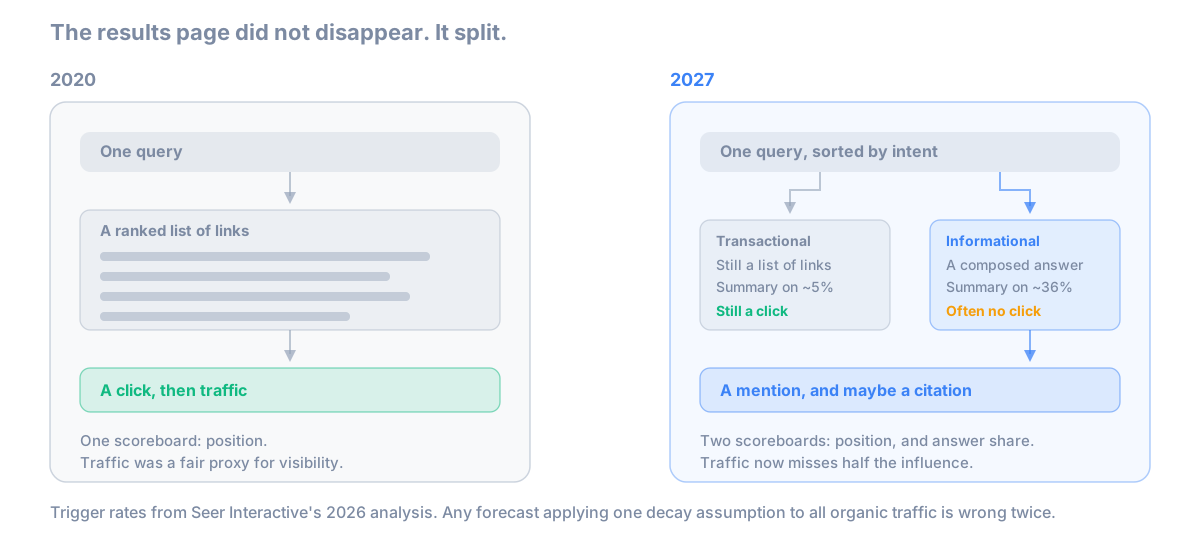
Four findings carry the argument. Each has a scope worth reading.
Clicks collapse where summaries appear. Seer Interactive measured organic CTR falling around 61% when an AI Overview is present, with citation inside the Overview recovering roughly 35% more clicks than exclusion.
The behaviour is real, not an artefact of impressions. Pew's browsing study of 68,879 searches found users clicking a traditional result on 8% of visits with a summary present versus 15% without, and ending the session on the results page 26% of the time versus 16%.
The damage is concentrated, not universal. Informational queries returned an Overview 36% of the time in Seer's dataset; transactional queries, 5%. Comparison queries hit 95.4%.
Assistants became a mainstream search habit. Pew's 2026 survey puts 49% of US adults using AI chatbots, with searching for information the single most common use at 42% of users.
Read together: the informational half of search stopped reliably producing clicks, the transactional half largely did not, and a parallel surface now handles a growing share of the research that precedes a purchase. Every claim below follows from that.
What survives
Crawling and indexing, entirely. Every answer engine retrieves from an index, and those indexes are built with the same machinery they always were. Robots rules, rendering, sitemaps, and site health did not become less important; they became load-bearing for a second channel. Anyone who told you technical SEO was commoditised was wrong before and is more wrong now.
Authority and topical depth. Retrieval favours sources that rank well for related queries. The mechanism by which a page enters a candidate set looks a lot like the mechanism by which it ranked, which is why an established site starts with a real head start on AI visibility.
Transactional search, more or less intact. At a 5% trigger rate, bottom-funnel queries still resolve to links. A store, a pricing page, a login, a comparison of two specific SKUs: these still work the way they did. Any forecast that applies a uniform decay to all organic traffic is wrong in both directions at once.
What dies
Position as the unit of success. This is the real casualty. Ranking first for a query whose answer is summarised above the links is a fact about eligibility, not about outcome. Rank becomes a leading indicator, useful and no longer sufficient, and every report built on position as the headline needs rebuilding.
The thin-page long tail. The economics of publishing a page per phrase variant depended on each page catching a trickle of clicks. When question-shaped queries get answered on the results page, that trickle stops and the pages become cost. Consolidation into fewer, denser pages is not a style preference now; it is what the incentive structure rewards. When a page collection is worth keeping, the publication check in programmatic SEO separates records that answer a distinct question from ones that only swap a name.
Traffic as the proxy for visibility. You can be named in three of five answers for your category's biggest buying question and see nothing in analytics, because the buyer never clicked. The measurement gap this creates is covered in AI search attribution, and it is why teams optimising for sessions alone will systematically misjudge which content is working.
What replaces them
Answer share becomes the headline metric. Mention rate, citation share, and share of voice against named competitors, all measured as rates over repeated runs. Definitions and how to read them together are in what is AI visibility. Expect these to be in board decks within two years and to be badly implemented for most of that time, because the sampling discipline is unfamiliar.
Third-party influence becomes a channel with a budget. This is the biggest organisational change and the one most teams have not costed. In our August 2026 study, vendor-owned domains took 15.3% of ChatGPT's citations and 3.9% of Perplexity's. If most of what an engine repeats about your category comes from pages you do not own, then the work of correcting and earning those pages is not PR overflow, it is core distribution.
Agent traffic becomes something you plan for. Crawlers and live-fetch agents already account for a meaningful share of requests on many sites, and they consume content without producing a session. Treating them as a cost centre to block is the wrong instinct; they are the delivery mechanism for the second channel. Which agents matter is in the AI crawlers guide.
The uncomfortable part
The open web has been funded, imperfectly, by the click. Publishers wrote answers, search sent traffic, traffic paid for the answers.
Answer engines break that loop by consuming the content and returning less of the traffic that funded it. Nothing about the current arrangement replaces the missing revenue. The likely outcomes are more content moving behind paywalls and logins, more licensing deals between large publishers and model providers, and a thinner free web of exactly the reference material these systems depend on.
That is a genuine problem for the ecosystem and, more narrowly, a strategic one for you: the third-party sources your category depends on may become fewer, more concentrated, and more expensive to influence. Building relationships with the ones that matter is cheaper now than it will be.
What this means for the job
The SEO role bifurcates along the same line as the discipline.
One half stays close to what it was: technical health, transactional intent, conversion, and the parts of search that still end in a click. This work is well understood and stays valuable.
The other half looks more like a mix of measurement and public relations. Designing prompt sets, reasoning about sampling variance, turning a cited-domain list into an outreach target list, and then doing the outreach that changes what those domains say. Less of the job is publishing pages; more of it is maintaining relationships.
The skills that transfer worst are the ones built on volume. The skills that transfer best are judgement about what deserves to exist, and the ability to get someone else to publish something accurate about you.
The falsifiable version
Predictions worth making are ones you can be wrong about in public, so here are three with dates.
By end of 2027, mention rate will appear alongside rankings in most enterprise SEO reporting. Not replacing it, sitting next to it.
Transactional organic traffic in 2027 will be within roughly 15% of where it is now, while informational organic traffic to non-brand pages will be materially lower. The split holds; the aggregate number hides it.
No major engine will publish an AEO ranking guideline. Google has already said there are no special optimizations for its AI features, and the incentive to document a system that would immediately be gamed does not exist.
If those are wrong, the argument on this page is wrong, and that is the point of stating them.
What to actually do
Stop forecasting organic traffic in aggregate; split the model by query intent and apply different assumptions to each half. Take a baseline on the second scoreboard now, while it is cheap and most competitors have not. And move some budget from publishing to influencing the sources that already shape your category's answers.
The practical version of all three is how to do AEO, the umbrella covering both halves of the shift is the AI SEO guide, the metrics are in what is AI visibility, and the numbers behind everything above sit in AI search statistics, with each study's scope attached so you can discount them as you see fit.