AI Monitoring Tools: What They Catch That Analytics Can't
AI monitoring tools sample what AI engines say about your brand: lost citations, competitor displacement, narrative drift, and factual errors on repeat.
 ChatGPT
 Claude
 Perplexity
 Grok
GrokOn this page
AI monitoring tools sample the answers AI engines give to your buyers' questions, on a schedule, and record what those answers say about you. To be clear about the category: this is monitoring what AI says about your brand, and tools that watch model latency, token spend, or server health share the name but do a different job. Brand-side AI monitoring, sometimes called AI search monitoring, exists because the three systems marketing teams already run are structurally blind to it: analytics sees only the visits that arrive, rank trackers see only the results page, and brand monitoring watches published text rather than generated answers.
The gap that leaves is not small. An engine can describe your pricing incorrectly to every buyer who asks for a month, and nothing in your stack will raise a hand.
What each system can actually see
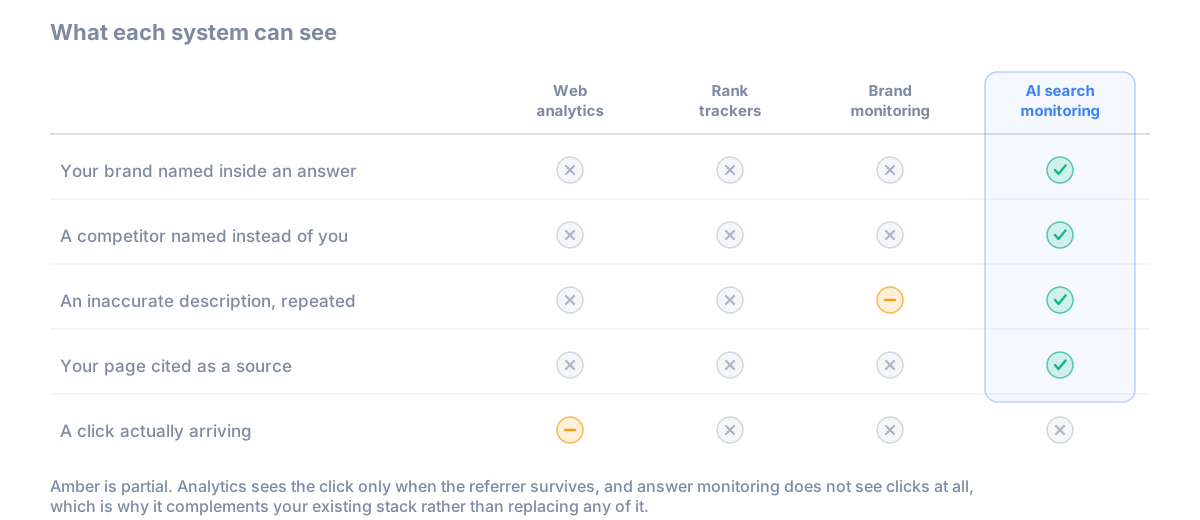
The blind spot has a simple mechanical cause. A buyer asks an assistant which tool to use, reads a three-brand answer, and forms a shortlist. If they click, the referrer is often stripped or unrecognized; if they do not click, no event exists at all. Either way the decision happened somewhere your instrumentation does not reach. The attribution side of this problem is covered in AI search attribution.
Rank tracking does not fill it either. Ranking first for your category term and going unmentioned in the assistant answer for the same question is a normal outcome, not an anomaly, for reasons worked through in AEO vs SEO.
Three things monitoring catches
The scenarios below are illustrative. They describe the shape of problems this measurement surfaces, not specific customers.
1. Narrative drift
The shape of it: an engine's one-line characterization of your product shifts. You were "the flexible option for growing teams" and now you are "a cheaper alternative with fewer integrations". Nothing on your site changed. What changed is the third-party page the engine leans on, perhaps a comparison roundup updated last quarter by someone who last looked at your product in 2024.
Why only monitoring catches it: the mention count is unchanged, so any metric based on presence stays flat. The damage is in the adjective, and you have to read the answers to see it, ideally scored on a scale so drift shows up as a number; brand sentiment tracking is that method.
What you do about it: find the source. The cited-domain list for the affected prompts usually names the page carrying the framing, which shrinks an open-ended reputation problem down to one outreach email.
2. Competitor displacement
The shape of it: a rival publishes a comparison page, gets added to two roundups, and starts appearing in answers where you used to be named alone. Your mention rate drops from 70% to 45% across six weeks while your traffic looks normal, because the buyers you lost never visited in the first place.
Why only monitoring catches it: this is a share-of-voice movement on the same prompts, invisible to any system that watches your brand alone. Scoring competitors on the same runs is what makes it legible, as covered in AI share of voice.
What you do about it: read what the engine cites when the competitor wins. It is usually two or three pages, and they are the same pages you need to be on.
3. Factual errors on repeat
The shape of it: an assistant states an old price, a discontinued plan limit, or a feature you never shipped. It does this consistently, because the claim sits in a source it trusts, and every buyer who asks gets the same wrong answer.
Why only monitoring catches it: there is no complaint, no support ticket, no bounce. The buyer simply believes it and moves on.
What you do about it: this is the highest-urgency category and often the easiest to fix, because correcting the source page is a concrete request with a clear ask. The full remediation playbook, including the harder sentiment cases, is in fixing negative brand sentiment in AI answers.
Notice what the three have in common. None of them show up as a number moving in a dashboard you already read, and all three are diagnosed by reading answers rather than counting them.
What monitoring will not do
Worth being direct, because the category oversells.
It will not attribute revenue. Monitoring tells you what engines say. Connecting that to pipeline needs separate work and remains genuinely hard.
It will not fix anything. It tells you where the problems sit. Somebody still has to write the page, correct the roundup, and chase the review site.
It will not give you a stable number. Answers vary between identical runs, so a monitoring product that reports a single check as a result is misleading you by design. In our August 2026 study, no prompt returned the same list of cited sources twice across five ChatGPT runs, with a median overlap of 4.8% between runs of the same prompt.
It will not replace your SEO reporting. Different layer, different questions, both still needed.
How monitoring improves an SEO strategy
The most practical answer is that it re-prioritizes the content queue using evidence you could not previously get.
Traditional keyword research tells you what people search and how hard the term is. Monitoring tells you which questions engines currently answer without you, which competitors they prefer, and precisely which third-party pages supply the recommendation. That is a different ranking of the same backlog.
Three concrete shifts it tends to produce. Comparison and alternatives pages move up, because those are the pages engines quote when buyers ask decision questions. Off-site work moves up sharply, since most citations point somewhere other than your domain. And technical crawlability work gets a deadline, because an engine that cannot fetch you produces a zero no amount of content fixes.
Comparing AI monitoring tools
Four questions separate the category, and none of them is the engine count on the homepage.
- How many runs per prompt per window, and is the count visible in the interface? Everything else follows from this.
- Does it store the full cited-source list, or only whether your domain appeared? The full list is what you act on.
- Are competitors scored on the same runs? Different runs make comparison meaningless.
- Can you get the data out? CSV or API, before you build reporting on it.
The full roundup with documented pricing sits in best AI visibility tools, the AEO-framed cut is in best AEO tools, and the eight-question buyer's checklist is in how to choose an AI visibility tool. Entry pricing across the category runs $20 to $99 a month, so this is a cheap thing to test and an expensive thing to guess about.
A first month that produces something
Week one, build a 20-prompt buyer question set and take a manual baseline: five runs each on two engines, scored for mention, position, citation, competitors, and accuracy. Week two, rank every cited domain by frequency and mark the third-party ones. Weeks three and four, act on the two most frequent, and re-measure.
That produces the three artifacts monitoring exists to give you: a rate you can trend, a competitor set you can watch, and a list of pages worth influencing. Whether you keep doing it by hand or automate it, those artifacts are the point. What is AI visibility defines the metrics behind them, and Citlyze runs the collection on a schedule once the manual version takes more hours than you can spare.