How to Track Brand Mentions in AI Search (2026 Guide)
Yes, you can track brand mentions in AI search. The exact method for ChatGPT, Perplexity, and Google AI Overviews, manual and automated.
 ChatGPT
 Claude
 Perplexity
 Grok
GrokOn this page
Tracking brand mentions in AI search is possible, and the method is simpler than most guides make it sound: ask the engines your buyers' questions on a schedule, record whether your brand appears in each answer, and compute the rate over repeated runs. What you cannot do is check once and call it data. AI answers change between identical runs, so mention tracking is a sampling exercise, not a lookup.
That distinction matters because the question behind the question is usually "is my brand losing deals I never see?" AI assistants recommend a handful of brands per answer and stop: in our 200-prompt study, the median answer named three to four brands in its category. If ChatGPT, Perplexity, and Google's AI Overviews name your competitors in your own category, buyers shortlist without you, and no analytics tool will ever show you the loss. Mention tracking is how you see it.
What counts as a mention, and what to record
A brand mention is your brand named in the generated answer text. It is related to, but distinct from, a citation, which is your domain linked as a source. Engines mention brands they never cite and cite pages that never mention you, a gap we unpack in a crawler visit is not a citation. Track both, and for each answer record four things: mentioned or not, position in the answer, sentiment of the framing (scored on a defined scale, per brand sentiment tracking), and which competitors appeared alongside you.
Position deserves more respect than it gets. "The best option for most agencies is X" and "other tools include X" are both mentions; only one wins deals.
The method
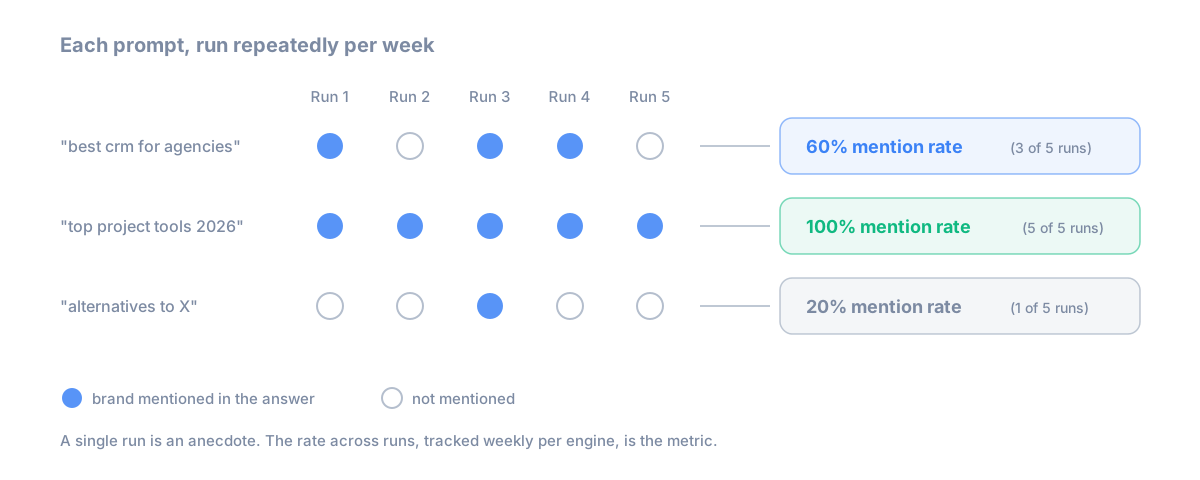
1. Build the prompt set. Full-sentence buyer questions, not keywords: money questions, comparison questions, problem questions. Between 15 and 100 prompts covers most programs; our guide to finding the prompts your buyers ask AI shows where to mine them.
2. Run each prompt repeatedly, per engine. Fresh sessions, clean accounts, several runs per prompt per week. One run is an anecdote; the grid above is a metric. The reasons variance is structural, and why sampling defeats it, are covered in why AI answers change.
3. Score and log. A spreadsheet with one row per run works: date, engine, prompt, mentioned, position, sentiment, competitors named, domains cited.
4. Trend weekly. The number that matters is not today's mention rate but the direction over six weeks, per prompt group and per engine. Competitor movement matters as much as your own: when a rival's rate climbs in your money prompts, you want the alert before the pipeline feels it.
Here is what a first real week tends to look like, so the shape does not surprise you. The rates differ sharply by engine: strong on the engine whose index favors your existing SEO, weak on another, absent on a third, because each engine retrieves differently. They differ by prompt type too, with comparison prompts usually your weakest group even when definitional prompts look fine, since comparisons are where engines lean hardest on third-party roundups. And at least one number will contradict your assumptions, most often the discovery that a review site or an old forum thread, not your own domain, is carrying your visibility. That per-engine, per-group split is the actual deliverable of week one; the blended average across everything is a vanity number.
Per engine, briefly
Each engine deserves its own protocol, and the mechanics differ enough that we wrote them up separately. ChatGPT is the highest-volume surface and the most personalization-sensitive; the ChatGPT-specific walkthrough lives in how to see and track brand mentions in ChatGPT. Perplexity cites sources aggressively, which makes it the most transparent engine to audit; our Perplexity brand monitoring page covers what tracking looks like there. Google's AI Overviews behave like a SERP feature rather than a chat, so presence and citation slots are the units of account; the tool landscape for that surface is in best AI Overviews trackers. Gemini shares Google's index but personalizes on account context, so how to track your brand in Gemini starts with a clean account. Grok's answers move with the live X conversation, which is why the Grok brand monitoring walkthrough leans hardest on run counts. And DeepSeek publishes no crawler and no first-party data, making the sampling protocol in DeepSeek rank tracking the only measurement there is, ideally run in the languages your buyers use.
Manual versus automated
The manual protocol above costs three to four hours a week for one engine at 25 prompts, and the cost scales linearly with engines and prompts. It is worth doing for two weeks regardless of budget, because nothing teaches you faster how AI systems talk about your market.
Past that point, teams automate. Citlyze runs the same protocol as software: your prompt set, repeated runs per measurement window, mention and citation detection, competitor share of voice on the same sampled answers, and Slack or Teams alerts when a rate moves, from $29/month across ChatGPT, Gemini, Perplexity, DeepSeek, ByteDance, and Google's AI surfaces. The prompt tracking feature page shows the views, and how those answers talk about you, not just whether they mention you, gets its own read on the brand perception page; the wider tool market, including our competitors, is compared in best AI visibility tools.
Whichever route you take, hold it to the same standard: run counts visible next to every rate. Software that shows a mention percentage without the number of runs behind it is a screenshot generator with a dashboard.
The mistakes that produce fake numbers
Four failure modes account for most bad mention data. Checking from your work account, where personalization has learned what you like, inflates your own visibility. Checking once per prompt turns variance into false trends; a brand "lost" a mention that was noise all along. Ignoring sentiment counts a "we do not recommend X for this" as a win. And tracking only your brand without competitors tells you your rate is 40% with no way to know whether that is dominance or disaster; share of voice against rivals on the same runs is the context that makes the number mean something, as covered in share of voice in AI answers.
Start with a baseline afternoon
For the metric definitions behind this protocol, what is AI visibility covers all five and how they read together, and AI search monitoring makes the case for running it continuously rather than once.
Per-engine walkthroughs go deeper where the mechanics differ: Perplexity hands you a full source list on every answer, and Microsoft Copilot is the only engine where the vendor reports your citations back to you for free.
Run your ten most commercial prompts on ChatGPT and Google today, fresh sessions, two runs each. Log mentions, positions, and cited domains. That baseline costs an afternoon and tells you whether you have a visibility problem worth automating. If you do, automate the protocol before it eats your Fridays; a trial workspace picks up exactly where the spreadsheet leaves off.