Free AI SEO Tools That Are Actually Free (2026)
Free AI SEO tools that do real work: page grading, crawler configuration, prompt research, and the first-party citation data nobody charges for.
 ChatGPT
 Claude
 Perplexity
 Grok
GrokOn this page
- Where the free line actually falls
- Free: check whether engines can use your pages
- Free: control which AI crawlers reach you
- Free: the first-party citation data almost nobody uses
- Free: work out what buyers actually ask
- Free AI rank tracking: the honest answer
- A free stack that actually does something
- When to start paying
Most "free AI SEO tools" lists are trial directories. This one is not: every tool below is free to use indefinitely, with no card and no countdown. That constraint rules out most of the AI visibility category, and being honest about why is more useful than padding the list.
The short version: the structural work is free, the demand research is free, and the first-party citation data is free. What is never free is continuously sampling AI answers, because every run costs someone an API call. We build Citlyze, which sells exactly that paid half and gives away the free half below.
Where the free line actually falls
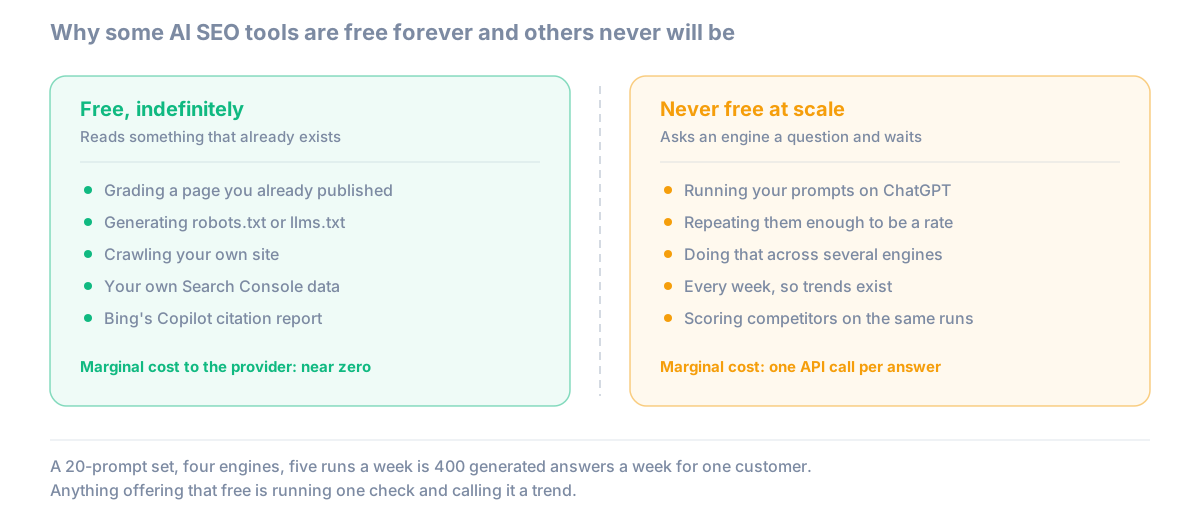
Free work reads something that already exists: your HTML, your robots.txt, your Search Console data. It costs whoever built the tool almost nothing, so it can stay free forever.
Paid work asks an engine a question and waits for a generated answer. That has a real per-run cost, and a meaningful measurement needs the same prompt run repeatedly across several engines every week. Multiply it out and you can see why nobody gives it away: a 20-prompt set on four engines at five runs a week is 400 generated answers a week for one customer.
Any tool promising continuous, free, multi-engine AI rank tracking is either running one check and calling it a trend, or about to introduce pricing.
Free: check whether engines can use your pages
AEO grader (ours). Paste a URL and get a 0 to 100 score on the structural things answer engines depend on: whether retrieval crawlers are blocked, whether the page has one descriptive H1, whether headings are question-shaped, and whether any paragraph could be lifted into an answer and still make sense. No signup, no model runs over your content.
AEO audit Chrome extension (ours). The same 0 to 100 grade as the web grader, run on whatever page you have open, plus two checks a web tool cannot do: how much of your content only appears after JavaScript runs, which most AI crawlers never see, and whether robots.txt allows each major AI bot on the exact path you are looking at. Everything runs in your browser, with no account and no server. Install it from the Chrome Web Store.
Screaming Frog SEO Spider, free up to 500 URLs. Enough to crawl most small sites completely. The free tier covers broken links, metadata, and sitemap generation, and it now supports calling OpenAI or Gemini mid-crawl, which turns an audit into a bulk classification job.
Schema markup generator (ours). Fill in a form and get copy-paste JSON-LD for Organization, WebSite, and SoftwareApplication, the entity types answer engines actually use to work out who you are, cross-linked with @id references. Deliberately no FAQ tab and no rating fields: the first stopped earning anything when Google retired FAQ rich results, and the second invites markup for reviews nobody collected. Runs entirely in your browser.
Google's Rich Results Test and the Schema Markup Validator. Free structured data validation, and the natural second step after generating markup above. Worth knowing that FAQ markup no longer earns a Google rich result, retired in May 2026, so validate Organization and product markup instead. The reasoning is in AEO website structure.
Free: control which AI crawlers reach you
AI crawler access checker (ours). The audit half of the crawler question: enter a URL and see which of 44 documented AI crawlers your robots.txt currently allows or blocks, with the exact rule that decided each verdict. The most common finding is a blanket block someone wrote years ago that still catches every retrieval crawler today, which is the single cheapest AI visibility fix that exists.
AI robots.txt generator (ours). Pick which AI crawlers to allow or block, from GPTBot to CCBot, and get a ready file. The decision matters more than most teams realise: blocking the search and live-fetch agents removes you from AI answers entirely, while training crawlers are a genuine policy choice. The framework is in the AI crawlers guide. Check first, then generate: the access checker above tells you what your current file already does.
WordPress AI crawler plugin (ours). The same check and the same choice, inside WordPress. On a WordPress site, robots.txt is assembled on the fly by core and by every SEO and security plugin you run, which is exactly where a rule nobody remembers writing tends to come from. The plugin reads the file your site actually serves, names the plugin, theme or setting behind each block, and applies a "block training, stay in AI search" rule set with a preview and an undo. Free on WordPress.org, with no account.
llms.txt generator (ours). Builds a curated index of your site in the proposed format. Honest caveat, and we would rather say it than sell it: no major engine documents reading llms.txt. It is cheap and harmless, and it belongs well below crawler access on your list. Our read on the evidence is in does llms.txt work.
llms.txt validator (ours). The companion check: point it at your site, or paste a draft, and get eleven structural checks against the format spec with line numbers on every problem. Paste mode runs entirely in your browser. The same honest caveat applies as for the generator; validate the file because you chose to publish it.
Free: the first-party citation data almost nobody uses
This is the most undervalued item on the page.
Bing Webmaster Tools, and specifically its AI Performance report. Microsoft reports your actual citations inside Copilot answers: total citations, per-URL counts, a sample of the grounding queries that retrieved your content, and, since a June 2026 expansion, intent classification and citation share. No third-party tool has this, because it comes out of Microsoft's own logs. It is free, and most teams have never opened it. How to read it is in Copilot rank tracking.
Google Search Console. Still the only first-party record of which queries Google shows you for and what gets clicked. AI feature traffic is folded into web search totals rather than broken out, which is a real limitation and not a reason to skip it.
Ahrefs Webmaster Tools, free for sites you verify, with a site audit covering 170-plus technical issues and limited backlink and keyword data for your own properties. Competitor analysis is the paid part.
Free: work out what buyers actually ask
AI prompt generator (ours). Enter your brand, industry, and competitors and get 20 buyer prompts worth tracking, grouped by journey stage and exportable as CSV. This is the input to everything else in AEO, and building the list is covered manually in finding the prompts your buyers ask AI.
Query fan-out simulator (ours). Shows how an engine expands one question into the sub-queries it actually answers. Useful mainly for Google AI Mode work, where covering the fan matters more than covering the headline query.
Google Search Console's query report, again. Your existing queries, classified by intent, tell you which parts of your traffic sit in the high-exposure informational band. The trigger rates are in what triggers AI Overviews.
Free AI rank tracking: the honest answer
This is the most searched thing on this page, so here it is plainly.
There is no free tool that continuously tracks your brand across AI answers. What exists:
One-shot checkers. Enter a brand, get a handful of prompts run once. Genuinely useful for finding out whether you are visible at all, and genuinely useless as a baseline, because identical prompts return different answers. In our August 2026 study, only 68.8% of brands that appeared in at least one run of a prompt appeared in all five runs of the same prompt. A single-pass check therefore misreports presence often enough to mislead you.
The manual protocol, which is free and works. Twenty buyer questions, five runs each in signed-out sessions, scored for whether you are named, who else is, and which domains get cited. It costs a few hours and produces a real baseline plus the ranked cited-domain list that tells you what to fix. The method is in tracking brand mentions in AI search.
Free tiers and trials, used deliberately. Most paid tools run 7 to 14 days. Set your prompt set up on day one and you get two real measurement windows out of it. That is not a free tool, and pretending otherwise is how these lists lose their usefulness.
Per engine, the free options differ. Copilot is the outlier: Bing Webmaster Tools gives you real citation data for nothing. Perplexity is the cheapest to learn from manually because it cites sources on essentially every answer, per Perplexity rank tracking. ChatGPT is the hardest, since it cites least.
A free stack that actually does something
In order, with nothing paid:
- Verify in Bing Webmaster Tools and Google Search Console. One sitting, and Bing hands you citation data no paid tool can match.
- Run the AEO grader on your five highest-intent pages. Fix whatever fails, starting with crawler access.
- Check your robots rules with the robots.txt generator (or the WordPress plugin, if that is what you run), and confirm your CDN is not blocking retrieval agents under a rule nobody remembers.
- Build a 20-prompt buyer question set, generated then pruned by hand.
- Run the manual baseline once. Five runs per prompt on the two engines your buyers use.
- Crawl with Screaming Frog free if your site is under 500 URLs.
That sequence costs nothing and produces the three things a paid tool would give you on day one: a structural fix list, a mention-rate baseline, and a ranked list of the third-party pages shaping your category.
When to start paying
One test: when re-running the manual protocol starts swallowing a full workday every week, the arithmetic has flipped. That usually happens somewhere past 20 prompts on two engines.
Until then, the free stack is not a compromise. It is the same work, done by hand, and doing it by hand for a fortnight teaches you more about how engines talk about your market than any dashboard will. When you do start comparing paid options, best AI visibility tools covers the category on documented pricing, best AI SEO tools organizes the wider market by job, and how much AEO costs sets software against the DIY and agency routes.