Best AI SEO Agencies and Services in 2026 (+ When to Skip Them)
AI SEO and AEO agencies compared: specialties, who each one fits, which publish pricing, and a framework for choosing between an agency, software, or both.
 ChatGPT
 Claude
 Perplexity
 Grok
GrokOn this page
An AI SEO agency does three things software cannot: it writes the content, it does the outreach that gets you into third-party sources, and it owns the programme so it does not fall off a marketer's week. What it does not do is measure better than a $29 tool, which is the single most useful thing to know before a sales call.
The seven that made the list are iPullRank, Siege Media, Animalz, NoGood, RevenueZen, Embarque, and RevvGrowth. Every one was checked on its own website in August 2026, and each entry says whether it publishes pricing. We build Citlyze, a measurement tool that competes with the reporting slice of what agencies sell and complements the rest, so read the framework at the end with that in mind.
How this list was built
Two rules, because agency roundups are usually built from other agency roundups.
Own sources only. Each agency's services and specialty come from its own site, not from a directory or a competitor's ranking. Where the site does not say something, this page does not either.
Pricing is reported as published or not published. Most agencies in this category do not publish rates. That is a normal enterprise sales motion, not a scandal, but it changes how you should evaluate them, and pretending to know their prices would be inventing numbers.
The field is considerably larger than seven. These are the ones whose AEO or GEO offering was verifiable from the source.
The agencies
| Agency | Specialty | Pricing |
|---|---|---|
| iPullRank | GEO as an engineering discipline | Not published |
| Siege Media | Full-service GEO, content and digital PR | Not published |
| Animalz | Subject-matter-expert editorial for B2B SaaS | Not published |
| NoGood | AEO inside a growth marketing squad | Not published |
| RevenueZen | B2B programmes with a defined GEO tier | $3,000 to $15,000/mo |
| Embarque | LLM SEO for startups and SaaS | $1,500 to $10,000/mo |
| RevvGrowth | AEO content production for B2B SaaS | From $3,000/mo |
iPullRank
Treats AI search as an engineering problem rather than a content one. Its services name generative engine optimization directly, alongside a broader "relevance engineering" framing that pulls together information retrieval, content strategy, digital PR, and UX. Technical SEO on complex legacy estates is the historical strength, and the buyer it addresses is a CMO with a department.
Fits: enterprises whose AI visibility problem is genuinely technical, or whose site is complicated enough that content alone will not move it.
Siege Media
Positions as a full-service GEO agency, with the line "we make brands the answer in search" and an offering that runs from strategy through content into digital PR, Reddit marketing, and original research. The Reddit and research pieces matter more than they sound: both target the source types that dominate AI citations.
Fits: brands that need the third-party layer built, not just pages published. Client roster skews to large SaaS, fintech, and ecommerce.
Animalz
An editorial shop that added AEO to its content programmes rather than repositioning around it. The differentiator is subject-matter-expert-led writing, which happens to be what earns citations from engines that favour substantive, quotable sources.
Fits: B2B SaaS companies whose problem is that their content is thin or generic, and who want depth rather than volume.
NoGood
Sells AEO inside a growth marketing engagement alongside paid, lifecycle, and CRO, with an in-house AI lab. The advantage is that AI visibility work sits next to the paid and conversion levers rather than in an SEO silo; the trade is that it is one line in a broader remit.
Fits: venture-backed companies that want AI search handled inside an existing growth team rather than as a separate workstream.
RevenueZen
One of the few agencies publishing a full price ladder: $3,000 a month for Foundation, rising through $5,000, $7,000, $10,000 and $15,000. The AI work is tiered explicitly, with generative engine topic research at $5,000 and a full GEO programme including quarterly audits and citation optimization at $10,000.
Fits: B2B teams that want to know what a real AEO programme costs before booking a call. The published tiering is also the clearest public answer to "what does a full GEO programme actually cost".
Embarque
Publishes four tiers at $1,500, $2,800, $5,200, and $10,000 a month with a three-month minimum, and names LLM SEO, GEO, and AEO as distinct services. The $1,500 entry point is the lowest verified agency rate on this list by some distance.
Fits: startups and smaller SaaS companies that need someone doing the work but cannot justify a $3,000 floor.
RevvGrowth
Publishes a $3,000 a month B2B SaaS package built around ten AEO-structured posts monthly plus schema, entity, and internal linking work. The deliverable is unusually specific for this market, which makes it easy to compare against your own production costs.
Fits: B2B SaaS teams whose bottleneck is content throughput in the right structure.
Agency, software, or both
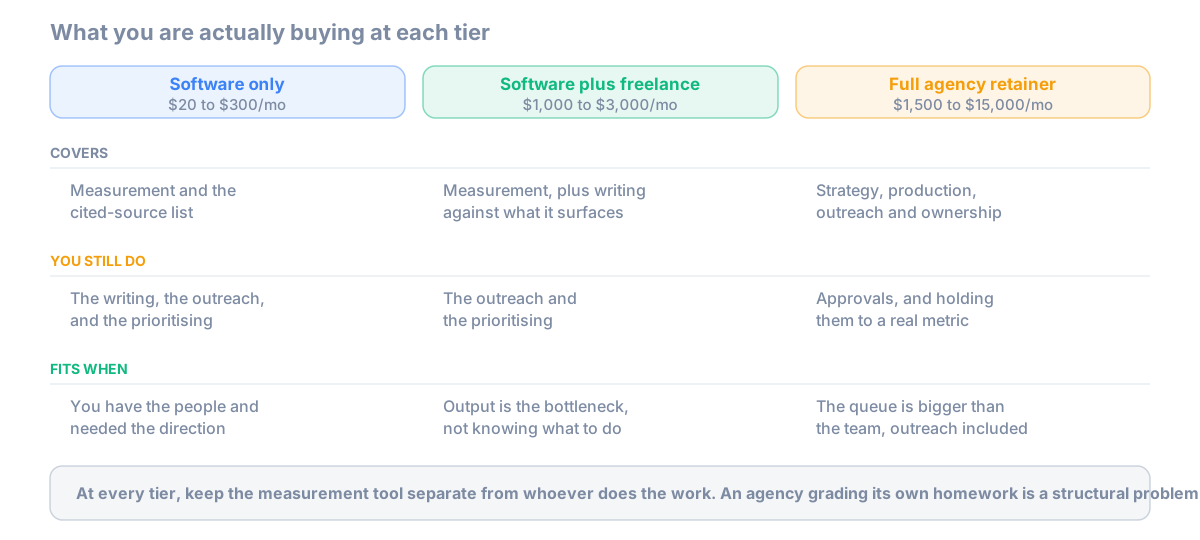
The choice is usually miscast as agency versus software. They cover different work, and the honest comparison is which parts of the job you need someone else to do.
Software only, $20 to $300 a month. You get measurement: mention rates, citation share, competitor movement, and the cited-domain list that tells you what to work on. You do the work. This is enough when you have someone who can write and someone who can do outreach, and the missing piece was knowing where to point them.
Software plus freelance production, roughly $1,000 to $3,000 a month. Measurement stays cheap, and you buy the writing against what it surfaces. Often the best value in the range, because you are paying for output rather than for account management.
Full agency retainer, $1,500 to $15,000 a month. You buy strategy, production, outreach, and someone owning the programme. Worth it when the queue exceeds the team, and especially when the third-party outreach half needs doing, since that is slow, relationship-driven work that in-house teams start with good intentions and quietly stop.
One structural recommendation regardless of tier: keep the measurement tool separate from the agency doing the work. An agency reporting on its own performance using its own tooling is a conflict no contract clause fixes. Independent measurement is cheap enough that there is no reason to accept it. The cost breakdown across all three routes is in how much AEO costs.
What to ask before signing
Six questions that separate a real AEO programme from SEO with new vocabulary.
- What is the deliverable in a month where the numbers do not move? AI visibility work has quarters like that. A good answer describes shipped work; a bad one describes a report.
- How do you measure, and how many runs per prompt? If the answer is a single check per prompt, the reporting is noise. The reasoning is in what is AI visibility.
- What fraction of the retainer is measurement? Measurement costs $20 to $300 a month. You should not pay a retainer multiple for it.
- Who does the third-party outreach, and what does it look like? This is the highest-leverage and least-automatable part of the work. If the answer is vague, the programme is a content programme.
- What happens to the assets if we leave? Prompt sets, historical data, and source lists should be yours.
- Can you show a before-and-after on a named metric? Not traffic. Mention rate or citation share on a defined prompt set.
Red flags specific to buying services
The pricing traps that apply to anyone selling AEO, including guarantees, dead schema levers, and fast-result promises, are covered in how much AEO costs. Four more show up only when you are buying people.
Deliverables counted in outputs. "Twelve posts a month" is a production quota, not an outcome. Ask what the twelve posts are supposed to move and how that gets measured. An agency comfortable with outcome language will offer it unprompted.
The pitch team is not the delivery team. Common in larger shops and rarely volunteered. Ask who writes, who does outreach, and who you speak to weekly, by name and seniority.
No answer on third-party sources. Since most citations point somewhere other than your domain, an agency that cannot describe which roundups, review platforms, and communities it will target is selling a content programme with AI vocabulary attached.
Reporting built on their own tooling only. Not disqualifying, but it means the party being graded is holding the pen. Independent measurement costs a fraction of the retainer, so there is no reason to accept the conflict.
If you are not sure yet
Take a baseline before you take a call. Twenty buyer prompts, five runs each, scored for mentions, citations, and competitors, gives you the one thing that makes agency conversations productive: a number the engagement is supposed to move, and a list of the third-party pages shaping your category.
Expect that baseline to change what you ask for. Sometimes the problem turns out to be technical and cheap; sometimes the entire issue is third-party coverage, which is precisely the work worth paying an agency for. How to do AEO is the playbook either way, and best AI visibility tools covers the measurement layer, ours included, on documented pricing. And if you are on the agency side of this table, the measurement layer agencies run client reporting on is our agencies solution.