Best AI Rank Trackers in 2026 (ChatGPT, Perplexity and More)
AI rank trackers compared: track your brand's position in ChatGPT, Perplexity, Grok, Claude, and Google AI Overviews, and what rank means in an answer.
 ChatGPT
 Claude
 Perplexity
 Grok
GrokOn this page
A rank tracking tool for AI works differently from the SERP trackers you grew up with, because AI answers have no position 3. The engines compose one answer per prompt, and your "rank" becomes three numbers: how often you are mentioned across repeated runs, where in the answer you appear, and how often your domain gets cited as a source. The best AI rank trackers in 2026 measure all three: Citlyze from $29/month, Rankscale from $20/month for the widest cheap coverage, and Profound for enterprise programs.
We build Citlyze, so audit this list against the linked sources, all of which were checked in July 2026.
What "rank" means in an AI answer
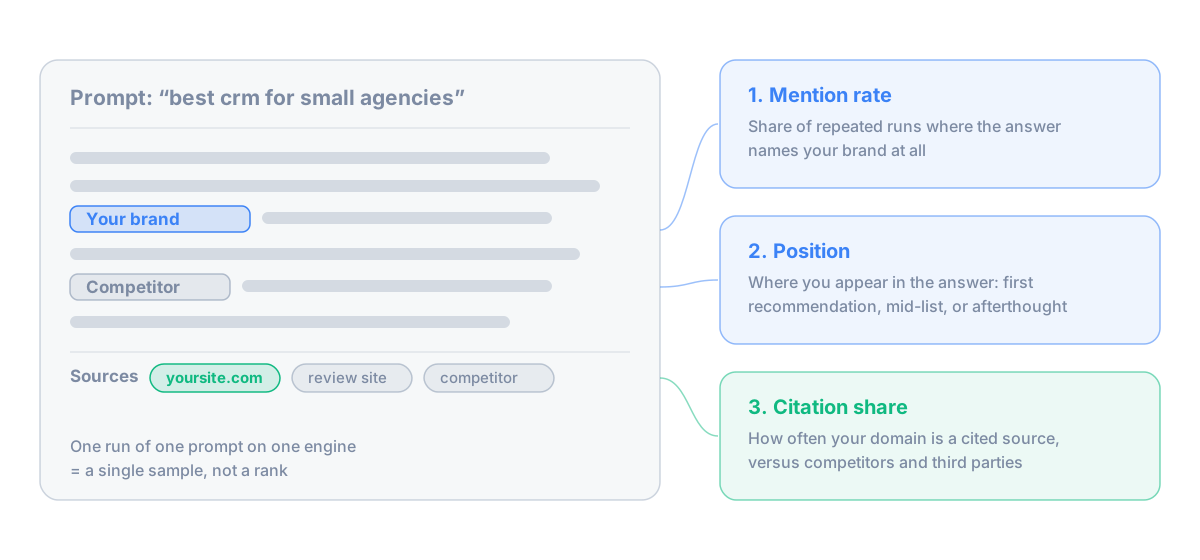
A single check of a single prompt is a sample, not a rank. Identical prompts return different answers run to run, so real tracking means repeated runs per prompt per engine, with rates computed over the window. When a vendor shows you a number without a run count, ask for the run count.
Position matters too, and it is harsher than a results page. Being the first recommendation in a ChatGPT answer is the new position one; being mentioned fifth in a list of "other options" is barely visibility at all. Our share of voice guide covers how to weigh the two against competitors.
Reading the three numbers together
The numbers only make sense as a set, so here is a worked example. Suppose a week of tracking on your money prompts returns a 60% mention rate, an average position of 2, and a 10% citation share. Read separately, the 60% looks healthy and the 10% looks alarming. Read together, they tell one story: the engines already believe you belong in the consideration set (they name you in most runs, near the top), but they are building that belief from other people's pages, since your own domain barely appears among the sources. Your visibility is real and rented. The work that follows is not "more mentions"; it is winning citations on the third-party pages carrying you, and publishing the answer-shaped pages that let engines cite you directly.
Reverse the numbers, a 20% mention rate with a 40% citation share, and the diagnosis flips: engines read your content and cite it for facts, but do not yet treat your brand as a recommendation. That usually points at the comparison surface: the "best X" and "alternatives to Y" pages where recommendations get formed, which either do not exist on your site or exist without answering the question. A tracker that only shows one of the three numbers cannot tell these two situations apart, and they require opposite work.
The trackers, compared
| Tool | From | Engines | Grok | Claude | Repeated-run rates |
|---|---|---|---|---|---|
| Citlyze | $29/mo | 8 surfaces incl. AI Overviews, AI Mode, Copilot | Higher tiers | No | Yes, run counts shown |
| Rankscale | $20/mo | 10 | Yes | Yes | Basic |
| Otterly.AI | $29/mo | 7 | No | Yes | Prompt-based |
| Knowatoa | $59/mo | 7 | No | Yes | Basic |
| Peec AI | $95/mo | 6 | No | No | Yes |
| Promptwatch | $95/mo | 10 | Yes | Yes | Basic |
| Profound | $99/mo | 9 | Yes | Yes | Yes |
Citlyze
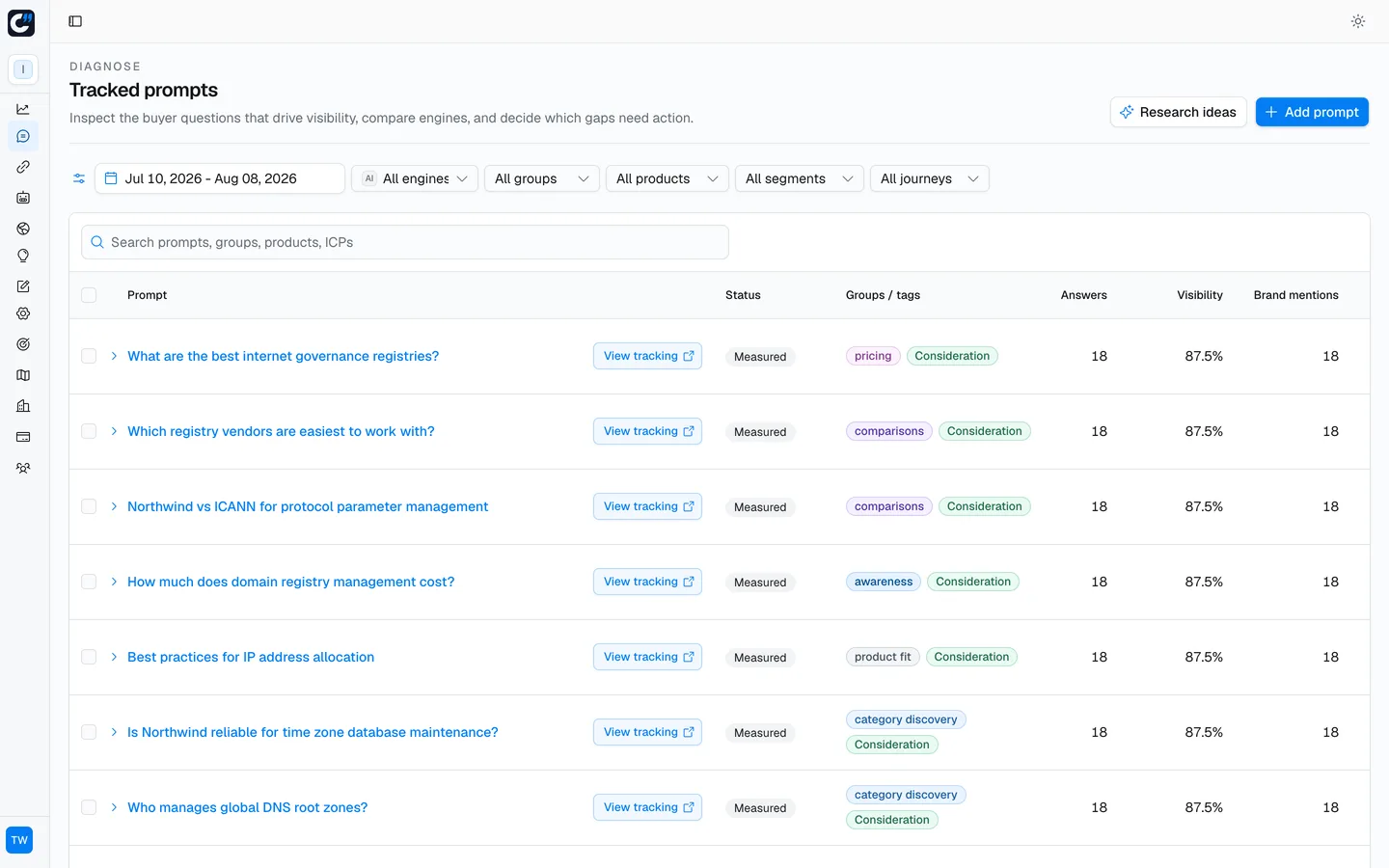
Citlyze treats rank tracking as a measurement problem: every prompt runs repeatedly per window on ChatGPT, Gemini, Perplexity, DeepSeek, and ByteDance, plus weekly Google AI Overviews, AI Mode, and Bing Copilot on every plan, with Grok on the higher tiers, and every rate ships with its run count. Mention rate, position, citation share, and competitor share of voice sit in one view, with alerts to Slack or Teams when a competitor displaces you. The AI rank tracker page breaks down what we sample per engine and what each rate means. What we do not do: Claude answers, and classic Google blue-link positions, where your existing SERP tracker stays.
Rankscale
Rankscale gives you ten engines, including Claude and Mistral, for $20/month, the lowest price to coverage ratio in the category. The reporting around the core numbers is leaner and sampling is shallower than the mid-range tools. As a first tracker, or a second opinion, it is hard to argue with.
Otterly.AI
Otterly.AI tracks prompts across seven engines including Claude from $29/month, with an interface built for marketers rather than analysts. Quotas at the entry tier are the constraint to check before buying.
Profound
Profound covers nine engines, the widest of the enterprise tier, wrapped in enterprise packaging: sales-led evaluation, from $99/month, no self-serve trial. The right call when procurement wants a vendor relationship; oversized when a team just needs numbers this week.
The mid-range: Peec AI and Promptwatch
Peec AI ($95/month, six engines) does agency reporting well, and its position tracking against named competitors is among the more readable in the category. Promptwatch ($95/month, ten engines) wins on breadth, reaching Mistral and Meta AI that few others sample. Neither leads on sampling depth; both are workable centers for a client reporting stack, and Knowatoa ($59/month, seven engines) sits just below them for teams that want guided setup more than reporting polish.
Tracking the awkward engines
Grok. Demand for Grok tracking is real and tooling is thin. Citlyze, Rankscale, Promptwatch, and Profound cover it, though check the tier in each case: on Citlyze it sits on the higher plans rather than the $29 entry, and our Grok visibility tracker page explains what we sample there. The measurement protocol, and why Grok's live X input demands more runs than any other engine, is in Grok rank tracking.
Claude. Claude sends less traffic than ChatGPT but its users skew technical and high-intent. Citlyze does not track Claude answers today; if Claude coverage is a hard requirement, Otterly.AI, Rankscale, and Profound all list it. This paragraph will change when our coverage does.
Bing Copilot. The one engine where free first-party data exists: Microsoft reports your actual citations inside Copilot answers through Bing Webmaster Tools, which no third-party tool can match. Our Copilot rank tracking guide covers pairing that report with prompt sampling.
Perplexity. The opposite problem, and the easiest engine here: it cites sources on effectively every answer, so tracking gives you the full source list rather than a yes or no. See Perplexity rank tracking for what to do with it.
Google AI Overviews and AI Mode. These behave like SERP features, not chatbots, so tracking is about trigger presence and citation slots. Several tools gate Google surfaces behind higher tiers; Citlyze includes them on every plan. More in our guide to tracking AI Overviews and AI Mode, with dedicated tool roundups for AI Overviews trackers and AI Mode tracking.
If you think about this market in terms of models rather than answer surfaces, LLM visibility tools sorts the same field by model coverage and explains why memory-mode and search-mode answers differ. If you also still need classic Google positions, best rank trackers covers that market and where the two overlap.
Free AI rank tracking
Free tiers in this category buy you one-shot checks, which answer "am I visible right now on this engine" and nothing else. That is a fine first step: run a handful of your money prompts manually, note who gets recommended, and you have a baseline audit by the end of the day. For rates and trends, compute costs make sustained free tracking rare; the cheapest continuous options are Rankscale at $20 and Citlyze or Otterly at $29, each with a trial to test against your prompt set first.
However you start, size the prompt set before the tool: 20 to 40 prompts that mirror real buyer questions beat a long keyword export, and our guide to finding the prompts your buyers ask AI walks through building the list.
Where to start
Pick the coverage you need from the table, shortlist two tools, and run your own 20 prompts through both trials in the same week. The comparison that decides it is not this article; it is your mention rate in one tool versus the other on identical prompts, and whether each shows you the sampling behind it. Ours is happy to be one of the two.