Profound AI Review 2026: Features, Pricing, and Alternatives
An honest review of Profound: what the platform does well, what each tier actually costs and covers, and which alternatives make sense for smaller teams.
 ChatGPT
 Claude
 Perplexity
 Grok
GrokOn this page
Profound is the best-funded platform in AI search visibility, and the most enterprise-shaped. It monitors how AI engines describe your brand, reports which prompts real users are asking, tracks how AI crawlers move through your site, and increasingly generates content aimed at getting cited. Pricing published in August 2026 runs $99/month for a ChatGPT-only Starter tier, $399/month for three engines on Growth, and custom pricing for the nine-engine Enterprise tier where most of the product actually lives.
We build Citlyze, which competes with Profound. That is a reason to check every figure below against Profound's own pricing page rather than take our word for it, and a reason we have kept the criticism to things you can verify yourself.
What Profound actually is
Profound organizes into three jobs, and the first is the one that earned it the category lead.
Monitoring. Answer Engine Insights tracks how engines describe and recommend your brand across tracked prompts. Conversation Explorer is the more distinctive piece: rather than only measuring the prompts you chose, it reports what people are actually asking AI in your category, drawn from a large real-user dataset. That is a genuinely different input from prompt-set tracking, and it is the feature competitors have the hardest time matching, because it is a data acquisition problem rather than an engineering one.
Agent Analytics. Server-side tracking of how AI crawlers, GPTBot, ClaudeBot, PerplexityBot and the rest, move through your site. Useful, and increasingly table stakes: our AI crawlers guide covers what this class of data can and cannot prove, and crawl versus citation covers why crawl volume is a leading indicator rather than a result.
Content and agents. Actions and Agents generate AI-targeted content: comparison pages, FAQ blocks, social posts. This is the newest and most speculative surface, and the part of the platform where claims outrun independent verification. Treat vendor-reported lift figures from any tool in this category, ours included, as marketing until you have measured the same thing yourself against a baseline.
The pricing ladder, read carefully
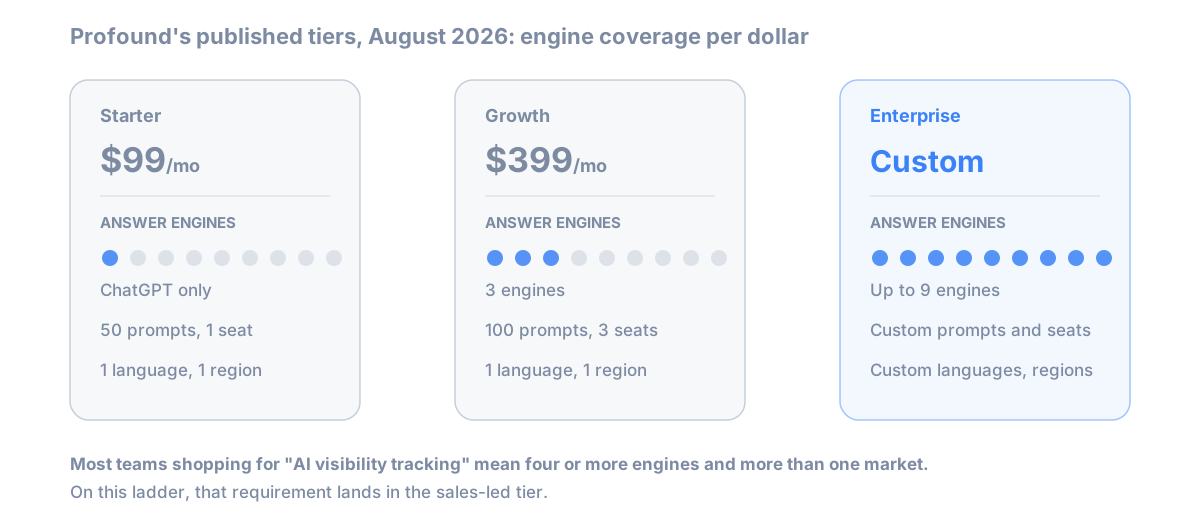
Profound's published tiers, as listed in August 2026:
| Tier | Price | Engines | Prompts | Seats |
|---|---|---|---|---|
| Starter | $99/mo (annual) | ChatGPT only | 50 | 1 |
| Growth | $399/mo (annual) | 3 answer engines | 100 | 3 |
| Enterprise | Custom | Up to 9 answer engines | Custom | Custom |
The number to sit with is the engine count. A team shopping for "AI visibility tracking" almost always means ChatGPT, Gemini, Perplexity, and Google's AI surfaces at minimum. On Profound, that is the $399 tier at best and a sales conversation at worst. Starter and Growth are also capped at one language and one region, which rules them out for anyone tracking more than a single market.
Prompt quotas deserve the same scrutiny. Fifty prompts on Starter is a workable set for one product line; 100 on Growth is tight for a multi-product company once you account for the comparison and alternatives prompts that actually decide deals. Our guide to finding buyer prompts typically produces 20 to 40 prompts per product line, which multiplies faster than these caps allow.
Who Profound is right for
Profound fits when three things are true at once: you are an enterprise with procurement expectations, you want the demand-side data that Conversation Explorer provides, and the difference between $400 and $4,000 a month is not the deciding factor.
The company's trajectory supports that positioning. Profound raised a $96 million Series C at a $1 billion valuation in February 2026, led by Lightspeed, bringing total funding to $155 million, and Fortune reported more than 700 enterprise customers including Target, Walmart, MongoDB, and Figma at that point. An earlier $35 million Series B was led by Sequoia. If your CFO asks whether the vendor will exist in three years, this is the easiest answer in the category.
The buying process matches. Enterprise procurement, SSO and SAML, SOC 2, dedicated Slack support, and a sales-led evaluation are all features when your security review needs them, and friction when you want numbers by Thursday.
When it is overkill
Three situations where we would not point someone at Profound, and none of them are about product quality.
You need four or more engines on a marketing budget. The gap between what Growth covers and what most teams mean by AI visibility puts you in Enterprise pricing for a capability several $29 to $99 tools ship on their entry plan.
You want to start this week. Enterprise evaluation cycles are measured in weeks. If the goal is a baseline mention rate before the next planning meeting, a self-serve trial gets you there faster, and the buyer's guide has the questions to ask whoever you shortlist.
Your question is narrow. If you only need to know whether Google AI Overviews cite you, a dedicated approach costs a fraction: see our AI Overviews tracker roundup. Buying a platform to answer one question is how software budgets die.
Profound alternatives worth shortlisting
Citlyze ($29/month) covers eight surfaces on every plan (ChatGPT, Gemini, Perplexity, DeepSeek, and ByteDance daily, plus weekly Google AI Overviews, Google AI Mode, and Bing Copilot), with Grok on the higher tiers, repeated runs per prompt, and the run counts shown next to every rate. Self-serve, no sales call. It does not track Claude, and it has nothing resembling Profound's real-user prompt dataset, which is the trade you are making. Comparison: Citlyze vs Profound.
Otterly.AI (from $29/month) is the lightest way into prompt tracking, with 15 tracked prompts on the Lite tier and 100 on the $189 Standard tier. Prompt quota is the thing to size before buying.
Rankscale (from $20/month) sits at the opposite end of the market from Profound: a long engine list, Claude included, priced below every Starter tier in this article, with reporting that stays light to match.
Scrunch (from $250/month annually) is the closest thing to Profound's agency and enterprise shape at published, self-checkable pricing, with 350 custom prompts on the entry tier.
Athena ($295/month) lands just above Scrunch's floor, and its free tier carries a small credit allowance, so you can preview how this class of enterprise product works without a contract or a call.
Evertune ($800/month for Pro) answers a different question at a different scale: category-wide brand measurement, sampled across 11 models at very high prompt volumes. Brand teams buy it; teams deciding which page to fix do not need it.
Head-to-head detail on the three most-compared platforms is in Profound vs Otterly vs Scrunch, and the wider field is in best AI visibility tools.
How to decide
Write down the engines you need, the number of prompts you will actually track, and the markets you sell into. Those three numbers land you on a tier before anyone shows you a demo, and they are the numbers that move the price by a factor of ten. If they put you in Profound's Enterprise band and your procurement process is comfortable there, it is a strong platform with the deepest demand-side data anyone is selling. If they do not, you are paying enterprise packaging for numbers that several self-serve tools produce, and that claim is checkable before procurement wakes up: start a self-serve trial on your own prompt list this week, and see whether the numbers you need were on a self-serve plan all along.