LLM SEO: Tools to Track Your Brand's Visibility in LLMs
How to check and track whether LLMs mention your brand: what LLM visibility tools actually measure, which ones cover which models, and what to ignore.
 ChatGPT
 Claude
 Perplexity
 Grok
GrokOn this page
An LLM visibility tool runs your buyer questions through language models on a schedule and reports whether each one names, cites, or recommends your brand. The useful ones separate two very different things: what a model says from memory, and what it says after searching the web. Most checkers only measure the second, and most buyers do not realise it.
"LLM SEO" is the umbrella term practitioners search for. It describes the same work as AEO and GEO, viewed from the model end rather than the answer end. The tools compared below, Citlyze, Rankscale, Otterly.AI, Profound, Athena, and Evertune, are graded on exactly that memory-versus-retrieval split, plus which models each one covers.
Two layers, and only one is really trackable
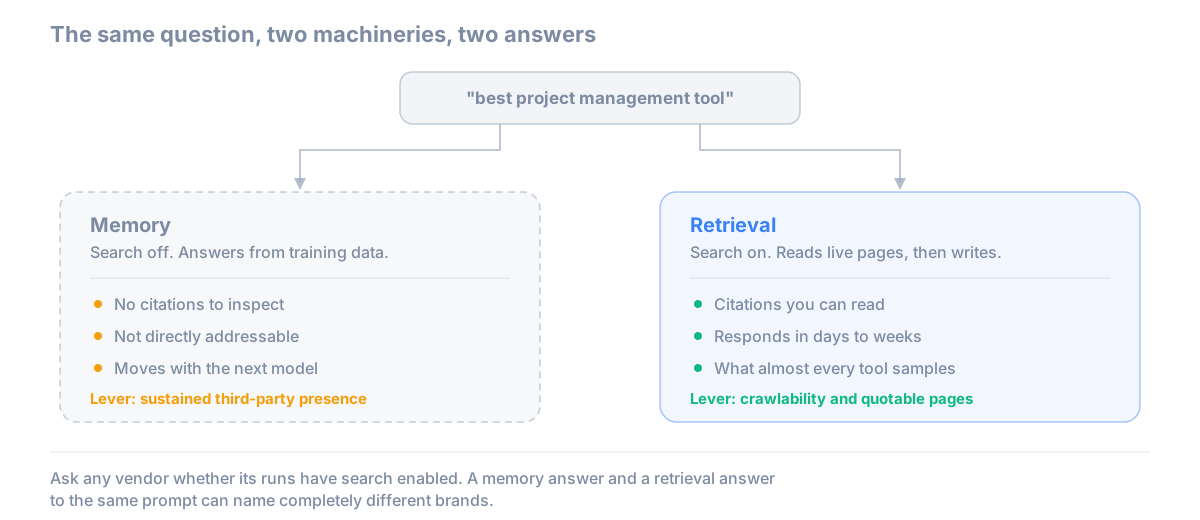
Memory. Ask a model "what are the best project management tools" with search turned off and it answers from what it absorbed in training. No citations, no live lookup, and no way to edit it directly. This layer changes only when a future model trains on a corpus that says something different about you, which is why third-party presence compounds so slowly and matters so much.
Retrieval. Turn search on, or ask something current, and the model searches, reads a handful of pages, and writes an answer grounded in them, usually with links. This layer responds within days to crawlability fixes and within weeks to content changes.
Nearly every tool in this category measures the retrieval layer, because that is the one an API can sample cheaply and reproducibly. That is a reasonable choice and rarely disclosed. When a vendor says it tracks Claude or Gemini, ask whether the runs have search enabled, because a memory-mode answer and a retrieval-mode answer for the same prompt can name different brands entirely.
Neither layer is optional. Retrieval decides today's answers; memory decides the ones given when nobody searches. The mechanics of how one particular model resolves this are in how ChatGPT picks its sources.
What a checker actually does
An "LLM visibility checker" is a one-shot version of the same idea: enter your brand and a category, and it runs a handful of generated prompts across two or three models and reports what came back.
Useful for exactly one thing, which is finding out whether you are visible at all. If you are named in none of the ten prompts, you have learned something real in two minutes.
Not useful for anything else, for a reason worth stating precisely. Identical prompts return different answers, and in our August 2026 study, only 68.8% of brands that appeared in at least one run of a prompt appeared in all five runs of the same prompt. A single-pass checker therefore has roughly a one-in-three chance of misreporting any given brand's presence. That is fine for a first look and useless as a baseline.
The tell for a serious tool is whether the interface shows you the run count behind every percentage. If it does not, the number is a screenshot.
Which models each tool covers
Model coverage is the axis that matters for an LLM-framed search, and it differs more than the marketing suggests. Prices are from each vendor's own pricing page, checked August 2026.
| Tool | From | Model coverage worth knowing |
|---|---|---|
| Citlyze | $29/mo | ChatGPT, Gemini, Perplexity, DeepSeek, ByteDance, plus Google and Bing surfaces. No Claude |
| Rankscale | $20/mo | Most models for the least money, including Claude and Mistral |
| Otterly.AI | $29/mo | Claude included at a low entry price, 15 prompts |
| Profound | $99/mo | ChatGPT only at entry; the nine-model list is Enterprise |
| Athena | $295/mo | Nine models on a credit system, plus a small free tier |
| Evertune | $800/mo | 11 models at very high prompt volumes |
Citlyze
Built around sampling depth rather than model count: every prompt runs repeatedly per window with the run count shown next to each rate, and competitors are scored on the same answers. The engine list per plan is on the AI visibility tracker page. The relevant gap for an LLM-framed buyer is Claude, which we do not track. If Claude is a hard requirement, three tools in this table have it and we do not. We build Citlyze, so weigh this entry accordingly.
Rankscale
Best value if the goal is literally "how many LLMs can I watch for the least money". Claude and Mistral coverage at $20 a month is unmatched. The trade-off is depth: fewer runs behind each number, and less reporting built around it. A sensible first tool or a second opinion.
Otterly.AI
The cheapest way to get Claude specifically, at $29 a month. The constraint is quota rather than coverage: the entry tier holds 15 tracked prompts, and a prompt tracked in a second market takes a second slot, so count prompts times markets before trusting the headline price.
Profound
Counted by models, the $99 entry plan buys exactly one: ChatGPT. Three engines arrives at $399, and the nine-model list the brand is known for sits in the Enterprise tier behind a sales process. Its distinctive asset is a real-user prompt dataset rather than model breadth, which is a different reason to buy it. Detail in our Profound review.
Athena and Evertune
Both sit above the self-serve market. Athena runs on a credit system at $295 a month, and its free tier includes a small credit allowance: enough to click around an enterprise product before anyone signs anything. Evertune covers 11 models at very high prompt volumes; the buyer is a brand team measuring what models say about an entire market, which is research work more than optimization work.
A broader comparison across the whole category, including the tools that do not frame themselves around models, is in best AI visibility tools and best AI rank trackers.
Coverage is not the deciding variable
Buyers shopping this category by model count usually pick wrong, because the count is the easiest number to compare and the least connected to outcomes.
Two things matter more. Sampling depth, because five runs on four models tells you more than one run on twelve. And whether your buyers actually use the model, since tracking Mistral in a market where nobody asks it anything tells you nothing you can act on.
The realistic answer for most teams is four to six surfaces: ChatGPT, Gemini, Perplexity, and Google's AI surfaces, plus Copilot if Bing matters in your market and Claude if your audience is technical. Everything past that is a dashboard decision rather than a visibility one.
What "LLM SEO" gets slightly wrong
The name imports an assumption worth discarding: that you optimize the model. You do not, and nobody outside a lab does.
What you actually influence is the retrieval layer that models read from, and the corpus of third-party writing that shapes what future models absorb. Both are content and outreach problems. In our study, vendor-owned domains took 15.3% of ChatGPT's citations and 3.9% of Perplexity's, which means most of what an LLM repeats about your category comes from pages you do not control.
So the practical version of LLM SEO is unglamorous: be reachable, be quotable, and be well described in the places the models read. The ordered version of that is how to do AEO.
What to do with the output
Whatever tool you land on, the deliverable that changes decisions is not the mention rate. It is the ranked list of domains cited across your prompts.
Sort it by frequency, mark each domain as yours, a competitor's, or a third party's, and read the third-party rows as a work queue. That table is the difference between knowing you are invisible and knowing where to go about it, and it is the first thing to check any trial produces.
For the metrics themselves and how to read them together, what is AI visibility is the reference. And before any subscription starts, make the shortlist prove itself on the questions your buyers actually ask: a trial fed your own prompts settles more than any coverage table, this one included.