Best Rank Trackers in 2026 (Google + AI Search)
Rank trackers compared for 2026, including the part most reviews skip: tracking your position inside AI answers, not just blue links.
 ChatGPT
 Claude
 Perplexity
 Grok
GrokOn this page
A rank tracker tells you where your pages sit in Google's results. In 2026 that is half a scoreboard, because the query types most likely to be summarised above the links are also the ones your buyers use for research. The best setup for most teams is a classic tracker for positions plus something that measures whether AI answers name you, and several vendors, Nightwatch, SE Ranking, and Semrush among them, now sell both, usually as separate line items.
Prices below came off each vendor's own pricing page in August 2026. We build Citlyze, which does the second job and not the first, and that limitation is stated plainly in its entry.
What a 2026 rank tracker has to cover
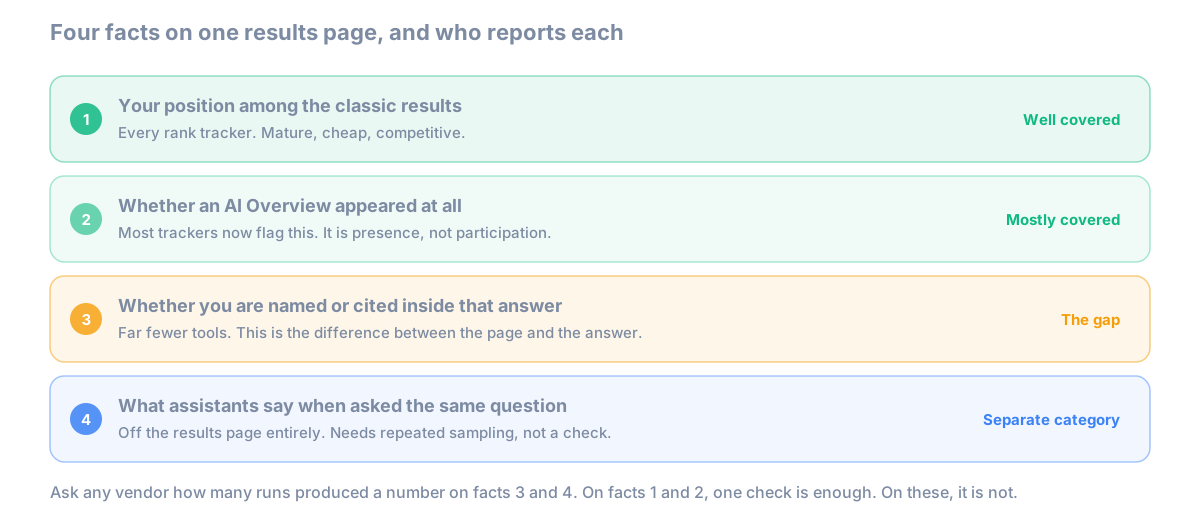
Four distinct facts hide inside a modern results page, and tools differ in how many they see.
- Your position among the classic results. Every tracker does this well.
- Whether an AI Overview appeared for the query. Most trackers now flag it.
- Whether you are named or cited inside that answer. Far fewer do this.
- What assistants say when asked the same question, which happens off the results page entirely and needs separate sampling.
Facts one and two are a mature, competitive, cheap market. Facts three and four are the newer category, covered in depth in best AI rank trackers.
The comparison
| Tool | From | Keywords at that price | AI coverage |
|---|---|---|---|
| Nightwatch | €79/mo | 500 | ChatGPT, Claude, Gemini, Perplexity, AI Overview, with response allowances |
| SE Ranking | $129/mo | 2,000 daily | AI Search add-on at $89/mo covers AI Overviews, AI Mode, Perplexity, ChatGPT |
| Semrush | $139/mo | Position tracking included | AI tracking bundled from the $199 tier, 50 prompts daily |
| Ahrefs | $29/mo Starter | Rank tracking by tier | 5 AI prompts on $129 Lite, 10 on Standard, 20 on Advanced |
| AccuRanker | $224/mo | 2,000 to 5,000 | Not stated on the pricing page; ask directly |
| Citlyze | $29/mo | No blue-link tracking | 8 answer surfaces, 5 daily prompts, run counts shown |
Nightwatch
The most interesting entry for this article, because it is a classic rank tracker that took the AI half seriously rather than bolting on a flag. €79/month for 500 keywords, €159 for 2,500, €399 for 7,500, and every tier carries an allowance of AI responses alongside the keyword count, across ChatGPT, Claude, Gemini, Perplexity, and AI Overview.
Best for: teams that want one tool covering both blue links and AI answers, and will accept a keyword limit that is low for the price. The response allowance is the number to size, not the keyword count.
SE Ranking
$129/month for 2,000 daily-tracked keywords, $279 for 5,000, with the AI Results Tracker sold as an $89/month add-on covering AI Overviews, AI Mode, Perplexity, and ChatGPT.
Best for: agencies that want a full SEO suite where the AI piece is a deliberate, priced choice. Worth noting that the add-on structure means the honest comparison price is $218/month, not $129.
Semrush
$139/month for the SEO plan, with AI visibility tracking bundled from the $199 Starter tier upward at 50 prompts tracked daily, 100 on the $299 tier, 200 at $549.
Best for: teams already inside Semrush. The marginal cost of adding the AI half is a plan upgrade rather than a new vendor, which is a real advantage when procurement is the slow part.
Ahrefs
Plans from $29 for Starter through $129 Lite, $249 Standard, and $449 Advanced. Rank tracking is solid throughout; the AI prompt allowances are small, at 5, 10, and 20 prompts by tier, with serious volume requiring a separate Brand Radar subscription in the several-hundred-per-month range.
Best for: link-driven programmes. Ahrefs' backlink data is the reason to be here, and the AI allowance is a taster rather than a measurement programme.
AccuRanker
$224/month for 2,000 to 5,000 keywords, $764 for the 10,000 to 25,000 band. Historically the speed-and-accuracy pick for large keyword sets, with on-demand refreshes that matter when you are tracking thousands of terms daily.
Best for: enterprise SEO teams whose primary problem is still large-scale position tracking. Its AI coverage is not stated on the pricing page, so make that an explicit question rather than an assumption.
Citlyze
Covers the fourth fact and not the first: eight answer surfaces on every plan from $29/month (ChatGPT, Gemini, Perplexity, DeepSeek, and ByteDance daily, plus weekly Google AI Overviews, AI Mode, and Bing Copilot), with Grok on higher tiers, repeated runs per prompt, and the run count shown next to every rate.
Not a rank tracker. There is no blue-link position data here, so if you need classic rankings, this is a second tool alongside one of the above rather than a replacement. We build it, which is why that sentence is in bold rather than buried.
The wider field is larger than six. Wincher, Advanced Web Ranking, Serpstat, and others remain credible; these are the ones whose current pricing and AI position we could verify from source.
How to choose
If your queries are mostly transactional, buy on classic tracking quality and price, and treat the AI features as a bonus. At a 5% AI Overview trigger rate on transactional queries, classic positions still decide almost everything you care about. The trigger data is worth checking against your own query mix before you spend anything.
If your queries are mostly informational or comparison-shaped, you need answer-level measurement, and you need it sampled properly rather than flagged. Comparison queries returned an AI Overview 95.4% of the time in Seer Interactive's dataset, so a tool that only tells you an Overview appeared is telling you something you could have guessed.
If you already own a suite, check what its AI tier costs before shopping. The upgrade is often cheaper than a new vendor and good enough to establish whether you have a problem.
If you are an agency, the deciding variables are seats, client workspaces, and white-label reporting rather than either kind of tracking.
The question that separates the two categories
Ask any tracker how many times it runs a prompt per measurement window, and whether that count is visible in the interface.
Classic rank tracking is close to deterministic: a position is a position, checked once. AI answers are not. Identical prompts return different answers, and in our August 2026 study only 68.8% of brands that appeared in at least one run of a prompt appeared in all five runs of the same prompt.
That difference is why the AI half of a suite is often thinner than it looks. A vendor applying rank-tracking assumptions to a probabilistic surface will happily report a single check as a result. If the run count is not on screen, treat the number as directional at best. The reasoning is in why AI answers change.
What to stop measuring
Two habits carried over from a world where position was the outcome.
Average position across a large keyword set. It was always a blunt metric and it is now actively misleading, because it moves for reasons that have nothing to do with whether anyone read your page.
Rankings as the sole proxy for visibility. You can hold position one and lose the click to a summary above it. That does not mean rankings stopped mattering; it means they became an eligibility measure rather than an outcome measure, an argument made in full in the future of SEO.
A sensible stack
For most mid-market teams: one classic tracker sized to your real keyword count, plus one answer-level tool sized to a 20 to 40 prompt buyer question set. Total cost lands between roughly $130 and $350 a month, which is less than the single-vendor suite upgrade that covers both half as well.
Before buying either, take a manual baseline on ten commercial questions so you know which half your problem is actually in. The method is in tracking brand mentions in AI search, the full answer-tracking market, ours included, is compared in best AI rank trackers, and the AI SEO guide sets both kinds of measurement in their wider context.