What Is a Google AI Overview? How Google's AI Answers Work
A Google AI Overview is the AI-generated summary at the top of some search results. What it contains, how it works, and what it means for your site.
 ChatGPT
 Claude
 Perplexity
 Grok
GrokOn this page
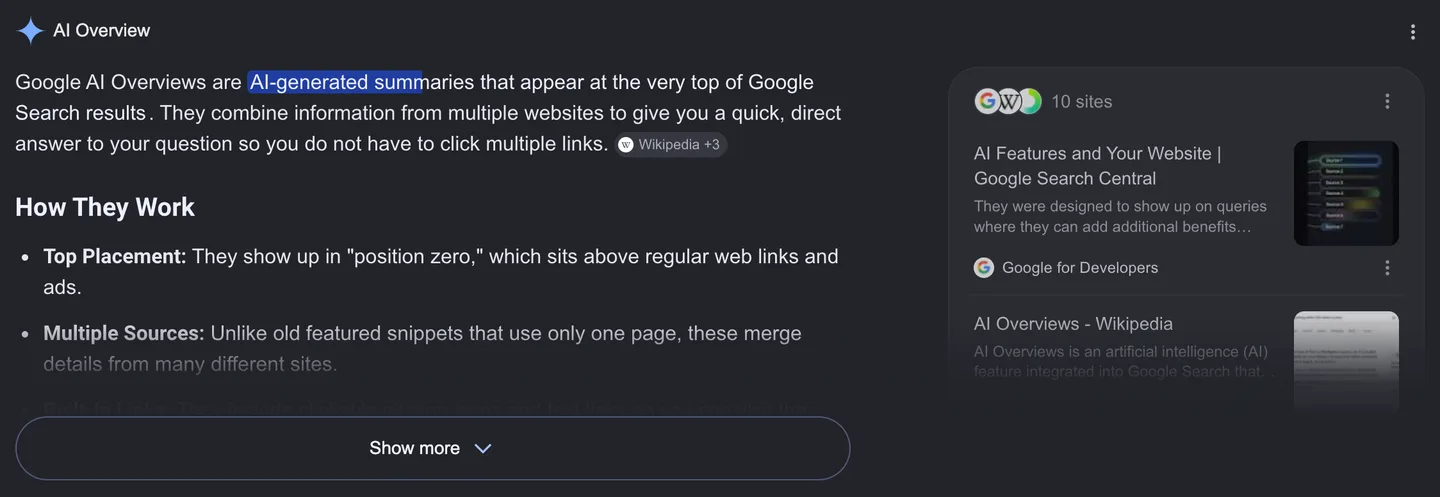
A Google AI Overview is the AI-generated summary that appears at the top of some Google search results, assembled by Google's Gemini models from pages in the search index and shown with links to the sources it drew on. It is not a chatbot and not a separate product: it is a block inside the ordinary results page, sitting above the organic links for queries where Google decides a generated answer helps.
The anatomy of an AI Overview
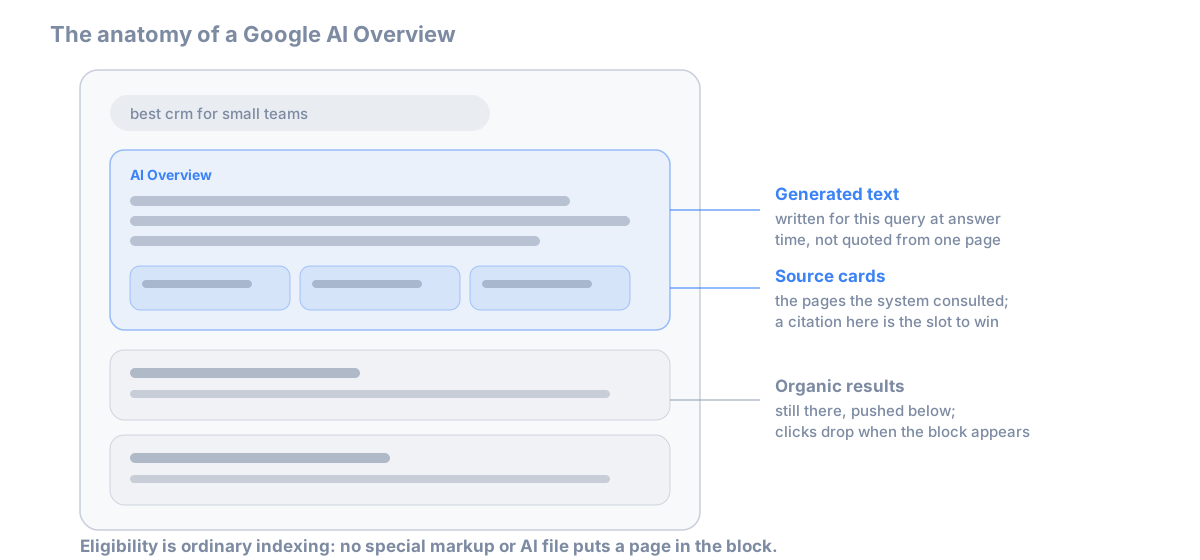
Three parts make up the block. The generated text is written for the query at answer time; it is not a quote lifted from one page, which is what separates it from the featured snippets Google has shown for years. The source cards link to the pages the system consulted, and they are the currency site owners compete for, since a citation there is the visible form of "being in the answer". The organic results still exist below, pushed further down the page. Pew Research measured what that placement does: users click links on roughly half as many visits when a summary sits on the page.
How AI Overviews work
The pipeline is retrieval plus generation. Google's systems take the query, pull candidate material from the same index that powers ordinary search, and have a Gemini model compose a summary over it, attaching links to the consulted pages. Google launched the feature to US users in May 2024 after a year of testing as "SGE", and has expanded it by country and query type since.
Two properties follow from that design and do most of the explaining. First, eligibility is ordinary indexing: Google's AI features documentation states there is no special markup and no AI-specific file that gets you in, so a page that can rank can be cited. Second, the output is generated fresh, so the same query can produce differently worded summaries, and sources can rotate between checks even while the underlying ranking barely moves.
When AI Overviews appear, and when they do not
Not every search triggers one. Question-shaped and informational queries trigger far more often than short navigational ones, and the published studies disagree on the exact rates because they sample different query sets. We keep the research synthesis in one place rather than repeating numbers here: what triggers Google AI Overviews walks through the studies, where they conflict, and what Google itself says.
AI Overviews, AI Mode, and Gemini are three different things
The naming trips people up, so the one-paragraph version: AI Overviews is the summary block inside normal search results. AI Mode is a separate conversational tab in Google Search that fans one question out into many background queries, covered in our AI Mode guide. Gemini is Google's standalone assistant with its own app, covered in Gemini rank tracking. All three draw on the same index, and each can talk about your brand differently on the same day, which is why they are measured as three surfaces rather than one.
What AI Overviews mean for your site
If your pages get cited, you gain a visible slot on queries where organic position alone no longer earns the click it used to. If the summary answers the question without citing you, you lose clicks you previously won, and nothing in your analytics explains why. The distance between those outcomes is mostly the work covered in our optimization guide for AI Overviews and AI Mode: answer-shaped content on crawlable pages, plus the off-site presence that makes your material worth consulting. The mechanism behind citation, and why being crawled is not the same as being cited, is in crawl versus citation.
How to see whether you appear in AI Overviews
Manually, you search your buyer questions and look, though the rotation between checks makes single looks unreliable. Continuously, tracking tools sample the queries on a schedule and record whether the block appeared, whether you were cited, and which sources filled it; the field is compared in best AI Overviews trackers, and Citlyze's own Google AI Overview tracker tracks the surface weekly on every plan. Search Console's Generative AI performance report adds impressions by page for AI Overviews and AI Mode, without queries or clicks.
Read the answer your buyers read
Pick the ten questions that decide purchases in your category and search them today. Note which trigger an Overview, what it says, and who it cites. That half hour tells you more about your exposure than any statistic in this article, because it is your queries, your market, and the actual words your buyers now read first. When you want that check running on a schedule instead of in a spare half hour, that is what Citlyze is for.